Dear Reader,
I really need to say something about the propensity of some sad forum personalities to continually see the need to belittle or deride this technology.
The fact that their comments are so ill considered and the fact that they indulge in a level of criticism that is entirely inappropriate - is also my comfort. Clearly they have all forgotten that all new discoveries depend on that early derision. It goes something like this. First the idea is scoffed - then it's denied - then it's considered to be self-evident. Fortunately - there are those who are already at the 'self evident' stage of this development. The scoffers are way behind.
What is particularly sad is that this is certainly NOT a new discovery. It depends on those very Laws that have been forged by our Giants in physics. All I have done is suggested that these Laws are, indeed, universally applied. To add to this point is the fact that I would never have been able to progress any part of this had it not been for the impeccable standards of some academicians to apply themeselves to all that experimental evidence. It is an enduring comfort to still find evidence of that pristine level of intellectual integrity - largely missing from the egocentric clamour of the 'forum'. Would that they exercised some kind of professional constraint and then their denials would be so much more credible. As it is their criticisms are discounted, precisely because of their excess.
May I remind those noisy detractors. I have done no-one any harm. I have simply proposed a new perspective on a really old truth. Why is there this need then to mock the idea? There are ideas out there in the world of science that are promoted by experts that are far, far, stranger than anything that I have ever proposed. And if you do not want to be associated with that thinking or any eccentric thinking - then there is always the very real option of dismissing the idea. That's it. Just let it go and move on.
Kindest regards,
Rosemary
Tuesday, February 22, 2011
68 - a partial replication of that earlier surprise
Dear Reader,
Here's that spike that I mentioned earlier. We've at least got this one on a semi-stable setting. The data dump taken off the multiple waveform screen shows a mean average current flow of -0.49amps (negative ie. back to the battery) Not as dramatic as was seen yesterday.


I have not managed to get a repeat on that runaway number. But I'll try again tomorrow.
Kindest regards,
Rosemary
Here's that spike that I mentioned earlier. We've at least got this one on a semi-stable setting. The data dump taken off the multiple waveform screen shows a mean average current flow of -0.49amps (negative ie. back to the battery) Not as dramatic as was seen yesterday.


I have not managed to get a repeat on that runaway number. But I'll try again tomorrow.
Kindest regards,
Rosemary


67 - something about Einstein's mass/energy equivalence
Dear Reader,
Just a quick reminder about the thesis. This, because one of the questions that was posed is 'how can the energy exceed the supply?'. I need to remind you all that I do not propose that there's any extra energy at all. I'm fully in synch with our classicists. Energy cannot be created nor destroyed. The difference is this. All matter has potential energy locked in its structure. That's Einstein's E = MC^2. What is proposed here is that if that structure is largely inductive or conductive - then those inductive and conductive properties can be exploited in the electromagnetic interaction. That way the material of the circuit components then becomes an energy supply source. This because the applied electric current flow 'releases' that locked energy.
Where in that structure this energy is located is then easily answered. Clearly it is NOT in the atoms themselves as they are not themselves 'changed' by that interaction. Therefore it must be outside the atomic structure. And since the only things that become 'changed' in an electromagnetic interaction - are the bound conditions of the molecules in the battery supply and the the bound conditions of the resistor and sundry circuit components - then one may propose that the binding of those material structures - molecular or atomic - is where this energy is actually located. Since we are not aware of anything other than the induced magnetic fields measured as voltage - then perhaps these fields are responsible for that bound condition. And then too, in as much as the atomic structures remain precisely as they were before that interaction, then perhaps they're extraneous to the atom itself. Surely from that premise to the proposal of 'hidden' or 'dark' energy is just a small but logical forward step? That, in any event, is where my own thinking leads.
So. Let's look at an example. We can burn a piece of wood and yet we would not alter any single atom in that entire structure. We'd only effect it's bound condition. We'd be left with a heap of ash - at best. Perhaps - in burning - those binding fields, like Elvis, just 'left the building'. Maybe they are just fields of 'binding matter' - hidden material that has moved from the wood into something else. Maybe they just dispersed in space to find some new 'home' or 'abode'? Some new atoms to 'bind'?
The difference in the electromagnetic interaction - is that these fields don't seem to go too far from the circuit itself. There is no actual 'conflagration' unless the applied current is that extreme. In which case the bound condition of that circuit component can be entirely compromised. But under usual conditions, our filaments - elements - all last a predetermined amount of time. At least long enough to justify their use.
But I do seriously propose that both that 'fire' and that heated element are indeed the consequence of change - not to the atom - but to something outside that atom that has, itself a material property. But these are hidden in a field condition. They're measurable and visible outside a field condition. And then they're experienced as 'fire' - in varying intensities and degrees - depending on the circuit material.
So. Back to that one overriding question. Are we simply referring to 'dark energy'? It would explain much that has been seen and measured by our astrophysicists. And it would certainly explain those questions raised by our string theorists. All that required matter. All those many dimensions. And all of it - entirely invisible.
Kindest regards,
Rosemary
Just a quick reminder about the thesis. This, because one of the questions that was posed is 'how can the energy exceed the supply?'. I need to remind you all that I do not propose that there's any extra energy at all. I'm fully in synch with our classicists. Energy cannot be created nor destroyed. The difference is this. All matter has potential energy locked in its structure. That's Einstein's E = MC^2. What is proposed here is that if that structure is largely inductive or conductive - then those inductive and conductive properties can be exploited in the electromagnetic interaction. That way the material of the circuit components then becomes an energy supply source. This because the applied electric current flow 'releases' that locked energy.
Where in that structure this energy is located is then easily answered. Clearly it is NOT in the atoms themselves as they are not themselves 'changed' by that interaction. Therefore it must be outside the atomic structure. And since the only things that become 'changed' in an electromagnetic interaction - are the bound conditions of the molecules in the battery supply and the the bound conditions of the resistor and sundry circuit components - then one may propose that the binding of those material structures - molecular or atomic - is where this energy is actually located. Since we are not aware of anything other than the induced magnetic fields measured as voltage - then perhaps these fields are responsible for that bound condition. And then too, in as much as the atomic structures remain precisely as they were before that interaction, then perhaps they're extraneous to the atom itself. Surely from that premise to the proposal of 'hidden' or 'dark' energy is just a small but logical forward step? That, in any event, is where my own thinking leads.
So. Let's look at an example. We can burn a piece of wood and yet we would not alter any single atom in that entire structure. We'd only effect it's bound condition. We'd be left with a heap of ash - at best. Perhaps - in burning - those binding fields, like Elvis, just 'left the building'. Maybe they are just fields of 'binding matter' - hidden material that has moved from the wood into something else. Maybe they just dispersed in space to find some new 'home' or 'abode'? Some new atoms to 'bind'?
The difference in the electromagnetic interaction - is that these fields don't seem to go too far from the circuit itself. There is no actual 'conflagration' unless the applied current is that extreme. In which case the bound condition of that circuit component can be entirely compromised. But under usual conditions, our filaments - elements - all last a predetermined amount of time. At least long enough to justify their use.
But I do seriously propose that both that 'fire' and that heated element are indeed the consequence of change - not to the atom - but to something outside that atom that has, itself a material property. But these are hidden in a field condition. They're measurable and visible outside a field condition. And then they're experienced as 'fire' - in varying intensities and degrees - depending on the circuit material.
So. Back to that one overriding question. Are we simply referring to 'dark energy'? It would explain much that has been seen and measured by our astrophysicists. And it would certainly explain those questions raised by our string theorists. All that required matter. All those many dimensions. And all of it - entirely invisible.
Kindest regards,
Rosemary
Monday, February 21, 2011
66 - yet more surprises
Dear Reader,
We are barely touching on the signifance of these effects. Since Friday I've found yet another waveform. A friend has taken downloads onto his flash drive today and I'll get my own download from this tomorrow. It's extraordinary. Something in the order of spikes at plus/minus 40 volts peak to peak measured across the shunt. Conservatively there's an estimated 80 to 100 amps in that really brief moment. And the battery voltage climbs dramatically.
Then. The flash drive left with it's owner. Another colleague of his came in to consider the simulation requirements. I had, by now, changed the frequency by another small adjustment to the duty cycle. The interval between those waveforms was reduced and the consequence was blow away. The resistor rocketed up to over 156 degrees. I turned off the system when it reached 168 degrees and climbing at speed. Still the values stayed negative. I'm hoping to duplicate that condition tomorrow and get the appropriate downloads. I'll let you know if this can be replicated. Ideally I need to video tape that event. But I'm not sure that I can manage the adjustments and the video taping. Perhaps I can get someone in to assist.
The real beauty of this new little number is that the mean average values still stay glued to those negative values.
I'm hoping that all this is repeatable. If not - it's not of too much consequence as our previous waveform is always there. That's more than enough for the demo. And all these other effects? Provided that our demo motivates enough interest - then I'm reasonably satisfied that it will all become apparent as this project is more carefully researched. Much needed. I have never expected that this energy is just so, so plentiful. But it relies on some careful tuning. I cannot see how this will ever be progressed without having broadband oscilloscopes. I foresee a big future in the market here.
Meanwhile - just to let you all know. I'm looking forward to that demo despite the scare that sits in the pit of my stomach and despite the sleepless nights. I've been largely reassured as the actual demo will be given by someone else. I'm reasonably satisfied I would not be equal to addressing a large group of people.
Kindest regards as ever
Rosemary
We are barely touching on the signifance of these effects. Since Friday I've found yet another waveform. A friend has taken downloads onto his flash drive today and I'll get my own download from this tomorrow. It's extraordinary. Something in the order of spikes at plus/minus 40 volts peak to peak measured across the shunt. Conservatively there's an estimated 80 to 100 amps in that really brief moment. And the battery voltage climbs dramatically.
Then. The flash drive left with it's owner. Another colleague of his came in to consider the simulation requirements. I had, by now, changed the frequency by another small adjustment to the duty cycle. The interval between those waveforms was reduced and the consequence was blow away. The resistor rocketed up to over 156 degrees. I turned off the system when it reached 168 degrees and climbing at speed. Still the values stayed negative. I'm hoping to duplicate that condition tomorrow and get the appropriate downloads. I'll let you know if this can be replicated. Ideally I need to video tape that event. But I'm not sure that I can manage the adjustments and the video taping. Perhaps I can get someone in to assist.
The real beauty of this new little number is that the mean average values still stay glued to those negative values.
I'm hoping that all this is repeatable. If not - it's not of too much consequence as our previous waveform is always there. That's more than enough for the demo. And all these other effects? Provided that our demo motivates enough interest - then I'm reasonably satisfied that it will all become apparent as this project is more carefully researched. Much needed. I have never expected that this energy is just so, so plentiful. But it relies on some careful tuning. I cannot see how this will ever be progressed without having broadband oscilloscopes. I foresee a big future in the market here.
Meanwhile - just to let you all know. I'm looking forward to that demo despite the scare that sits in the pit of my stomach and despite the sleepless nights. I've been largely reassured as the actual demo will be given by someone else. I'm reasonably satisfied I would not be equal to addressing a large group of people.
Kindest regards as ever
Rosemary
65 - some answers to some questions
Dear Reader,
This is just to asnwer some of those questions that have been put to me on forums.
Poynty - we did do a waveform directly across the load resistor - courtesy a very special little DSO. Here's the link. (Blog 54. I see I've incorrectly numbered two of them the same. In any event. You'll see which is which)
The waveforms across the shunt and the load are about 30 degrees out of phase. (sorry I edited this having written 70 degrees - incorrectly) But they follow the same general shape above and below zero. I am not sure of the significance of this but was assured that it was to be expected. My flashdrive was incompatible and I could not download the waveforms. But I hope to have that instrument for the 12th March demo.
TK - no aliasing whatsoever. And we've many downloads on the required 4 cycles. My only concern when we use so few samples is that the mean averages and that math trace become even more apparently advantageous. I prefer the more modest result from multiple waveforms. It seems to trend to a more conservative value that also matches the apparent energy dissipated at the load.
Also for Poynty. There's nothing wrong with our diodes - I assure you.
Many thanks to all those who have written in to show their support. It all helps. I confess to feeling more than a little nervous at the prospect of the demonstrations. But as someone else will be giving the demo then that fear is a partially abated.
Kindest regards,
Rosemary
ps. Also to mookie. I read your post with interest. Thank you for your efforts. Rather daunting to think that this could result in a lifetime of derision. But as I'm already so old - then I doubt that would be too long to endure. And I'm not concerned about the consequences to my reputation. I have none. But I would be very sorry if I dealt this science a harmful blow - ever. I doubt that I'd be able to survive that disappointment. I have been entirely seduced both by the logic and this general unfolding. It's been extraordinary. And in the wild hopes that this gets accredited as an anomaly - even then the tribute is hardly to my own efforts. It's very a much a joint endeavour shared by the hard work and hopes of thousands of us poor 'free energy addicts'. It's with some certainty to say that this energy is very much required.
Kindest
Rosemary
This is just to asnwer some of those questions that have been put to me on forums.
Poynty - we did do a waveform directly across the load resistor - courtesy a very special little DSO. Here's the link. (Blog 54. I see I've incorrectly numbered two of them the same. In any event. You'll see which is which)
The waveforms across the shunt and the load are about 30 degrees out of phase. (sorry I edited this having written 70 degrees - incorrectly) But they follow the same general shape above and below zero. I am not sure of the significance of this but was assured that it was to be expected. My flashdrive was incompatible and I could not download the waveforms. But I hope to have that instrument for the 12th March demo.
TK - no aliasing whatsoever. And we've many downloads on the required 4 cycles. My only concern when we use so few samples is that the mean averages and that math trace become even more apparently advantageous. I prefer the more modest result from multiple waveforms. It seems to trend to a more conservative value that also matches the apparent energy dissipated at the load.
Also for Poynty. There's nothing wrong with our diodes - I assure you.
Many thanks to all those who have written in to show their support. It all helps. I confess to feeling more than a little nervous at the prospect of the demonstrations. But as someone else will be giving the demo then that fear is a partially abated.
Kindest regards,
Rosemary
ps. Also to mookie. I read your post with interest. Thank you for your efforts. Rather daunting to think that this could result in a lifetime of derision. But as I'm already so old - then I doubt that would be too long to endure. And I'm not concerned about the consequences to my reputation. I have none. But I would be very sorry if I dealt this science a harmful blow - ever. I doubt that I'd be able to survive that disappointment. I have been entirely seduced both by the logic and this general unfolding. It's been extraordinary. And in the wild hopes that this gets accredited as an anomaly - even then the tribute is hardly to my own efforts. It's very a much a joint endeavour shared by the hard work and hopes of thousands of us poor 'free energy addicts'. It's with some certainty to say that this energy is very much required.
Kindest
Rosemary
Sunday, February 20, 2011
64 - a general appeal
Dear Reader,
We're leading up to our demonstration - planned for the 12th March 2011. I've asked both Stefan and Aaron to post news of this. My hope is that it will focus some internet attention on the demonstration and to alert you all to this.
Please may I impose on you all to spread the word. I would be glad if there could be some internet focus on this event. I will be inviting a reporter to the demonstration - but would prefer to keep it prescribed to 1 or 2 at the most. This to ensure that the news is not 'blown' out of proportion and that the reporting itself is handled responsibly.
Kindest regards,
Rosemary
We're leading up to our demonstration - planned for the 12th March 2011. I've asked both Stefan and Aaron to post news of this. My hope is that it will focus some internet attention on the demonstration and to alert you all to this.
Please may I impose on you all to spread the word. I would be glad if there could be some internet focus on this event. I will be inviting a reporter to the demonstration - but would prefer to keep it prescribed to 1 or 2 at the most. This to ensure that the news is not 'blown' out of proportion and that the reporting itself is handled responsibly.
Kindest regards,
Rosemary
63 - the circuit to test for the simulation
Dear Reader,
I suspect I'm boring you all with all this repetition. But I need to make this point as poyntedly clear as possible. To anyone who wishes to simulate that waveform - I propose that it may be achieved if you assume the following circuit.
Two rechargeable batteries are in parallel. A resistor with a small associated inductance is in series with the drain of battery one - with a switch and with a positively biased diode where the cathode is against the positive terminal of battery 2.
A second rail leads from the positive of battery 2. A resistor with a small associated inductance is also placed in series with the drain of battery 2 - with a switch and with a positively biased diode where the cathode is against the positive terminal of battery 1.
The switches work in antiphase that only one battery can deliver energy at any one time. You can use a solid state MOSFET type with a body diode driven by a 555 or by a functions generator. I think you'd need one switch for each rail - but have no idea how you determine the 'on' 'off' time of them both. Hopefully you guys will know.
A common rail links the negative of both batteries. A shunt resistor is in series with both negative rails in order to determine rate of current flow.
I am not sure what is required to ensure that both batteries sustain a different pd to each other. I'm afraid you guys will need to sort that out.
The switches work in antiphase. If the battery 1 is closed, then battery 2 is open. And when battery 2 is closed battery 1 is open.
I'm reasonably satisfied that the waveform across either battery and the shunt resistor will correspond to the this one where the two waveforms are in antiphase to each other

If so, then I'd modestly propose that our own circuit seems to indicate that there's an alternate energy supply source.
Kindest regards,
Rosemary
POST SCRIPT
It seems I've confused everyone. Abject apologies. The circuit described here is only theorised. I've never built it. Our circuit is substantially the same as it's ever been. Here I've proposed that this be tested only to see if a second supply will then generate the waveforms that we're getting. I thought it would be an articulate means of proving that our resistor/element is also an energy supply source. That speaks to the 'thinking' which is my best euphemism for 'thesis'. Apologies for the mix up. Clearly my writing is worse than ever I realised.
What I'm hoping Poynty - is that the waveforms will now move in antiphase. It'll be an interesting study.
I suspect I'm boring you all with all this repetition. But I need to make this point as poyntedly clear as possible. To anyone who wishes to simulate that waveform - I propose that it may be achieved if you assume the following circuit.
Two rechargeable batteries are in parallel. A resistor with a small associated inductance is in series with the drain of battery one - with a switch and with a positively biased diode where the cathode is against the positive terminal of battery 2.
A second rail leads from the positive of battery 2. A resistor with a small associated inductance is also placed in series with the drain of battery 2 - with a switch and with a positively biased diode where the cathode is against the positive terminal of battery 1.
The switches work in antiphase that only one battery can deliver energy at any one time. You can use a solid state MOSFET type with a body diode driven by a 555 or by a functions generator. I think you'd need one switch for each rail - but have no idea how you determine the 'on' 'off' time of them both. Hopefully you guys will know.
A common rail links the negative of both batteries. A shunt resistor is in series with both negative rails in order to determine rate of current flow.
I am not sure what is required to ensure that both batteries sustain a different pd to each other. I'm afraid you guys will need to sort that out.
The switches work in antiphase. If the battery 1 is closed, then battery 2 is open. And when battery 2 is closed battery 1 is open.
I'm reasonably satisfied that the waveform across either battery and the shunt resistor will correspond to the this one where the two waveforms are in antiphase to each other

If so, then I'd modestly propose that our own circuit seems to indicate that there's an alternate energy supply source.
Kindest regards,
Rosemary
POST SCRIPT
It seems I've confused everyone. Abject apologies. The circuit described here is only theorised. I've never built it. Our circuit is substantially the same as it's ever been. Here I've proposed that this be tested only to see if a second supply will then generate the waveforms that we're getting. I thought it would be an articulate means of proving that our resistor/element is also an energy supply source. That speaks to the 'thinking' which is my best euphemism for 'thesis'. Apologies for the mix up. Clearly my writing is worse than ever I realised.
What I'm hoping Poynty - is that the waveforms will now move in antiphase. It'll be an interesting study.
Saturday, February 19, 2011
62 - how about it Poynty?
Dear Reader,
it seems that Poynty Point will consider anything in his simulator bar the possibility of actually testing the thesis itself. This is a sad tribute to that 3rd school mindset that I've referred to earlier. And if it were a trivial matter I'd still joke about it. But it's not.
Pointy, the art of debunking is - possibly - required. Especially when what is being debunked is obviously being perpetrated as a deliberate fraud. But what is at issue here is not a fraud. I would not have the skills required to fabricate a waveform in any event. All those resistances and what have you in series with the gate of the MOSFET. Golly. I wouldn't know where to begin. We're looking at waveforms that are either the result of some intrinsic corruption in the circuit components - or we're looking at an alternate energy supply source. And there is nothing corrupted in our MOSFETS.
So. Test it Poynty Point. If you don't, I assure you that others will. And then your counter arguments here will be entirely irrelevant. What exactly are you scared of? That you'll duplicate the waveform - and thereby show that the thesis may be correct? And what harm? It would be of riveting interest to the guys at Caltech. and it would be memorable piece of simulation. I rather hoped you'd be equal to all sides of this argument. That's the base requirement for a serious experimentalist. Surely? Failing which, I'm afraid that your integrity will remain questionable. It's one thing to pose as a serious researcher. That's deserving of every respect. But it carries certain obligations that require objectivity and impartiality. I'm not sure that you're equal to it. Sadly.
Kindest regards,
Rosemary
it seems that Poynty Point will consider anything in his simulator bar the possibility of actually testing the thesis itself. This is a sad tribute to that 3rd school mindset that I've referred to earlier. And if it were a trivial matter I'd still joke about it. But it's not.
Pointy, the art of debunking is - possibly - required. Especially when what is being debunked is obviously being perpetrated as a deliberate fraud. But what is at issue here is not a fraud. I would not have the skills required to fabricate a waveform in any event. All those resistances and what have you in series with the gate of the MOSFET. Golly. I wouldn't know where to begin. We're looking at waveforms that are either the result of some intrinsic corruption in the circuit components - or we're looking at an alternate energy supply source. And there is nothing corrupted in our MOSFETS.
So. Test it Poynty Point. If you don't, I assure you that others will. And then your counter arguments here will be entirely irrelevant. What exactly are you scared of? That you'll duplicate the waveform - and thereby show that the thesis may be correct? And what harm? It would be of riveting interest to the guys at Caltech. and it would be memorable piece of simulation. I rather hoped you'd be equal to all sides of this argument. That's the base requirement for a serious experimentalist. Surely? Failing which, I'm afraid that your integrity will remain questionable. It's one thing to pose as a serious researcher. That's deserving of every respect. But it carries certain obligations that require objectivity and impartiality. I'm not sure that you're equal to it. Sadly.
Kindest regards,
Rosemary
61 - just a way to stress those rigid paradigms yet further
Dear Reader,
I've been asked to give a full description of circuit and circuit components. I won't do this prior to the demo. Therefore, technically, it will need to wait until the 15th of March or thereafter. The simple facts are that Fuzzy et al - lurk - with as much menace as ever. Quick to deride or decry - and either way - may well, and again, attempt to usurp or deny these results. Either way I'm not sure that the technology would survive a second attack. And I've run out of the required energy to fight it all again. I want academic accreditation to precede disclosure on the internet. Frankly I have no reason, whatsoever, to distrust mainstream. I only know that they've been indifferent and entirely sceptical. I've learned better than to ever again trust our internet personalities.
But the actual simulation does not depend on precise circuit components. What needs to be tested is this. Assume that there is no body diode. And assume that there's an alternate energy supply source. With those two items factored in - then I'm reasonably satisfied that you'll get a waveform precisely as we manage on our circuit. It will have the added advantage of evaluating the actual thesis which everyone, thus far, has chosen to ignore.
If, indeed, current flow has these properties of 'dual charge' and if there is an energy supply source extraneous to atoms - then the actual beneficiary will be our entire scientific community and their required skills to apply this knowledge. Then - to those who can operate those simulators - here's the carrot. The first person who actually finds this will be in the happy position of proving the thesis. And that proof would be conclusive - provided only that I can then show that our body diodes are in tact.
I would have thought that this could be a desirable test. Certainly with all that promising conservation of charge - the simulation should attract a certain amount of interest.
Just a thought.
Kindest as ever,
Rosie
I've been asked to give a full description of circuit and circuit components. I won't do this prior to the demo. Therefore, technically, it will need to wait until the 15th of March or thereafter. The simple facts are that Fuzzy et al - lurk - with as much menace as ever. Quick to deride or decry - and either way - may well, and again, attempt to usurp or deny these results. Either way I'm not sure that the technology would survive a second attack. And I've run out of the required energy to fight it all again. I want academic accreditation to precede disclosure on the internet. Frankly I have no reason, whatsoever, to distrust mainstream. I only know that they've been indifferent and entirely sceptical. I've learned better than to ever again trust our internet personalities.
But the actual simulation does not depend on precise circuit components. What needs to be tested is this. Assume that there is no body diode. And assume that there's an alternate energy supply source. With those two items factored in - then I'm reasonably satisfied that you'll get a waveform precisely as we manage on our circuit. It will have the added advantage of evaluating the actual thesis which everyone, thus far, has chosen to ignore.
If, indeed, current flow has these properties of 'dual charge' and if there is an energy supply source extraneous to atoms - then the actual beneficiary will be our entire scientific community and their required skills to apply this knowledge. Then - to those who can operate those simulators - here's the carrot. The first person who actually finds this will be in the happy position of proving the thesis. And that proof would be conclusive - provided only that I can then show that our body diodes are in tact.
I would have thought that this could be a desirable test. Certainly with all that promising conservation of charge - the simulation should attract a certain amount of interest.
Just a thought.
Kindest as ever,
Rosie
60 - ta muchly
Dear Reader,
I must say that I'm in awe of Poynty's and Humbugger's technical knowledge. I have to perform all kinds of mental gymnastics to get past those tedious acronyms - but when I finally manage that I see the genius involved in reverse engineering. And surprisingly, I think I'm beginning to understand how school 'classical' thinks. The only criticism that I have is that they both insist that my writing is less than obscure - if you can manage that double negative. It's when a double negative does not become positive. LOL I rather prided myself on the idea that I was articulate. But 'clearly' not. I"ll need to do better. Here's my first best effort.
What I find intriguing is that if you apply a material dual charge property to current - which, by the way, precludes electrons as they're monopoles - then that resonance - indeed any type of resonance on this circuit - is immediately explicable. Just a thought. I've always sort of depended on this - from the beginning. In other words, I predicted that the flow of current would be bi-directional depending on the applied voltage. And when it flows in 'the opposite direction' then it also presents and alternate charge. That way, and only in that way, can you get that energy going back through the diode. And the strength of that resonance? That means that there may be an alternate supply source on the circuit. Surely? That way you can eliminate all those tedious possibilities. And better yet. You won't need to reference those acronyms.
Jokes aside. Thanks for your efforts - Poynty Point and Humbybugger. I'm learning lots - but I think I'm the only beneficiary here.
Kindest regards,
Rosie
I must say that I'm in awe of Poynty's and Humbugger's technical knowledge. I have to perform all kinds of mental gymnastics to get past those tedious acronyms - but when I finally manage that I see the genius involved in reverse engineering. And surprisingly, I think I'm beginning to understand how school 'classical' thinks. The only criticism that I have is that they both insist that my writing is less than obscure - if you can manage that double negative. It's when a double negative does not become positive. LOL I rather prided myself on the idea that I was articulate. But 'clearly' not. I"ll need to do better. Here's my first best effort.
What I find intriguing is that if you apply a material dual charge property to current - which, by the way, precludes electrons as they're monopoles - then that resonance - indeed any type of resonance on this circuit - is immediately explicable. Just a thought. I've always sort of depended on this - from the beginning. In other words, I predicted that the flow of current would be bi-directional depending on the applied voltage. And when it flows in 'the opposite direction' then it also presents and alternate charge. That way, and only in that way, can you get that energy going back through the diode. And the strength of that resonance? That means that there may be an alternate supply source on the circuit. Surely? That way you can eliminate all those tedious possibilities. And better yet. You won't need to reference those acronyms.
Jokes aside. Thanks for your efforts - Poynty Point and Humbybugger. I'm learning lots - but I think I'm the only beneficiary here.
Kindest regards,
Rosie
Friday, February 18, 2011
59 - close but no cigar
Dear Reader,
This is for Poynty
Thanks for the efforts here. But you've not given us a replication. I don't think that PSpice can manage it - quite frankly - unless and until it can trace the battery voltage as a direct product of the current through the shunt resistor. It really needs to show that second order phase shift as you term it. Also. See if you can do something where the resonance ramps up rather than down as it progresses.
Poynty. It bothers me that you're so easily satisfied with an explanation. Your reasons are wrong. Transistor Zener very much in tact. And there's no variation if and when we put the probes directly on the battery terminals. And you're rather keen on using your standard DMM. If you put the setting to AC it will show that negative battery voltage. But it never exceeds zero to the extent that you've shown it. Look again at our traces. The battery voltage 'flirts' with zero at best - and only now and then does it actually breach that level - and then only by a fraction.
Kindest regards,
Rosie
I keep trying to post the link. It's not taking it. Here's the best I can manage.
http://www.overunityresearch.com/index.php?topic=13.msg10980;topicseen#msg10980
PS - it seems that I've again exposed my 'amateurish' status. LOL. MH - take it as read that this is the fact. However, to clarify that AC setting of your standard DMM - here's what's meant. Poynty insists that we do not need those sophisticated DSO's. I needed to cater to his preference. (another edit) As well as putting the DSO probes closer to the battery terminals - I also used a standard DMM on the battery, putting these probes directly on the battery terminals. And on a DC setting it's rock solid at a given value. On an AC setting, interestingly, it moves all over the place - even into negative - but never to the extent of those voltages that PSpice shows.
Regards,
R
This is for Poynty
Thanks for the efforts here. But you've not given us a replication. I don't think that PSpice can manage it - quite frankly - unless and until it can trace the battery voltage as a direct product of the current through the shunt resistor. It really needs to show that second order phase shift as you term it. Also. See if you can do something where the resonance ramps up rather than down as it progresses.
Poynty. It bothers me that you're so easily satisfied with an explanation. Your reasons are wrong. Transistor Zener very much in tact. And there's no variation if and when we put the probes directly on the battery terminals. And you're rather keen on using your standard DMM. If you put the setting to AC it will show that negative battery voltage. But it never exceeds zero to the extent that you've shown it. Look again at our traces. The battery voltage 'flirts' with zero at best - and only now and then does it actually breach that level - and then only by a fraction.
Kindest regards,
Rosie
I keep trying to post the link. It's not taking it. Here's the best I can manage.
http://www.overunityresearch.com/index.php?topic=13.msg10980;topicseen#msg10980
PS - it seems that I've again exposed my 'amateurish' status. LOL. MH - take it as read that this is the fact. However, to clarify that AC setting of your standard DMM - here's what's meant. Poynty insists that we do not need those sophisticated DSO's. I needed to cater to his preference. (another edit) As well as putting the DSO probes closer to the battery terminals - I also used a standard DMM on the battery, putting these probes directly on the battery terminals. And on a DC setting it's rock solid at a given value. On an AC setting, interestingly, it moves all over the place - even into negative - but never to the extent of those voltages that PSpice shows.
Regards,
R
Thursday, February 17, 2011
58 - another general update on the planned demonstration
Dear Reader
I am not sure that the waveform can be duplicated on a simulator. I'd be interested to see if this is, in fact, possible. Perhaps our Poynty can give this a go. I am delighted, in any event, to see that it's being denied on the basis of a faulty IRFPG50. It's an intriguing number. I think, in fairness, the person that first found this negative triggering was Aaron Murakami - and that by accident. It's just unfortunate that to see the full effect one actually needs a really broad band DSO. And to hold the pattern one needs something a little more reliable than a 555. In any event, the results are unequivocal. And on this particular setting it shows infinite co-efficient of performance. I think Harvey, for one, denied the general effect on the basis of the temporary nature of the data capture. There was an implicit suggestion that the data - over a short period - was not, necessarily, representative. That 50 second number should put that argument to bed.
I can assure you all that the resonance sustains itself. At slower frequencies we get an identical pattern but with a far longer interval of resonance. Of interest is that this seems to be a rock solid resonating condition. Very intriguing - from so many levels. I'm still of the opinion that the only possible explanation of this - dare I say it - is in that 'thinking' that preceded the experiment. But I'm open to correction. Time alone will tell. And I'm most interested to read of some kind of serious analysis applied. If, as I recommend - one simply allows a material property and a dual charge in the current then all is very easily reconciled. Hopefully that explanation will be considered - eventually.
Meanwhile - just a quick update on the demonstration. We will be sending invitations to all our campuses for a demo to be held on Saturday the 12th of March, 2011 - to view the demonstration and accredit the results. In order to 'fit in' with the onerous demands of those heavy academic timetables, we'll also be offering optional more private viewings during the week from the 11th through to the 14th for those who can't make it on Saturday. But we'll only be sending out the invitations during the course of next week. The Saturday viewing will be the official demo and hopefully, we'll be able to get a reporter there.
This will give me the time to settle the variations that we would also need to show and it should allow more time to collate yet more data. I also have to list those many questions that are still outstanding. The most intriguing is that the phenomenon is definitely dependent on the resonating condition of the circuit. And while the resonance is replicable - it is also both elusive and subtle. There is much to be researched. And it needs to be left in the capable hands of serious researchers. Hopefully the demos will be the required catalyst. Certainly I hope that we can prepare a paper on this prior to that demonstration.
So dear Reader. I trust that we can get this to the desks of our learned and revered that they can determine what gives. When and if I see that this is being constructively managed - then I can bow out. It really only needs the trained academic mind to resolve this. And my own contributions here are really and only in as much as I have - I hope - pointed to those questions especially as it relates to the material property of current itself.
Kindest regards,
Rosemary
I am not sure that the waveform can be duplicated on a simulator. I'd be interested to see if this is, in fact, possible. Perhaps our Poynty can give this a go. I am delighted, in any event, to see that it's being denied on the basis of a faulty IRFPG50. It's an intriguing number. I think, in fairness, the person that first found this negative triggering was Aaron Murakami - and that by accident. It's just unfortunate that to see the full effect one actually needs a really broad band DSO. And to hold the pattern one needs something a little more reliable than a 555. In any event, the results are unequivocal. And on this particular setting it shows infinite co-efficient of performance. I think Harvey, for one, denied the general effect on the basis of the temporary nature of the data capture. There was an implicit suggestion that the data - over a short period - was not, necessarily, representative. That 50 second number should put that argument to bed.
I can assure you all that the resonance sustains itself. At slower frequencies we get an identical pattern but with a far longer interval of resonance. Of interest is that this seems to be a rock solid resonating condition. Very intriguing - from so many levels. I'm still of the opinion that the only possible explanation of this - dare I say it - is in that 'thinking' that preceded the experiment. But I'm open to correction. Time alone will tell. And I'm most interested to read of some kind of serious analysis applied. If, as I recommend - one simply allows a material property and a dual charge in the current then all is very easily reconciled. Hopefully that explanation will be considered - eventually.
Meanwhile - just a quick update on the demonstration. We will be sending invitations to all our campuses for a demo to be held on Saturday the 12th of March, 2011 - to view the demonstration and accredit the results. In order to 'fit in' with the onerous demands of those heavy academic timetables, we'll also be offering optional more private viewings during the week from the 11th through to the 14th for those who can't make it on Saturday. But we'll only be sending out the invitations during the course of next week. The Saturday viewing will be the official demo and hopefully, we'll be able to get a reporter there.
This will give me the time to settle the variations that we would also need to show and it should allow more time to collate yet more data. I also have to list those many questions that are still outstanding. The most intriguing is that the phenomenon is definitely dependent on the resonating condition of the circuit. And while the resonance is replicable - it is also both elusive and subtle. There is much to be researched. And it needs to be left in the capable hands of serious researchers. Hopefully the demos will be the required catalyst. Certainly I hope that we can prepare a paper on this prior to that demonstration.
So dear Reader. I trust that we can get this to the desks of our learned and revered that they can determine what gives. When and if I see that this is being constructively managed - then I can bow out. It really only needs the trained academic mind to resolve this. And my own contributions here are really and only in as much as I have - I hope - pointed to those questions especially as it relates to the material property of current itself.
Kindest regards,
Rosemary
Wednesday, February 16, 2011
57 - waveforms - 180 degrees out of phase
Dear Reader,
I took the trouble to do a series of downloads just to compare values. I'll download some of those pictures but need to do a detailed schedule of results. Note that the values remain negative - proof of infinite co-efficient of performance and our resistor is dissipating plus/minus 6 watts in temperature. Just out of interest that beautiful waveform entirely disappears at below 36 volts from the supply.
Kindest regards,
Rosemary
CHANNEL 1 shunt @ 0.25 Ohm
CHANNEL 2 battery
CHANNEL 3 gate
CHANNEL 4 math trace product of channel 1 and 2


I took the trouble to do a series of downloads just to compare values. I'll download some of those pictures but need to do a detailed schedule of results. Note that the values remain negative - proof of infinite co-efficient of performance and our resistor is dissipating plus/minus 6 watts in temperature. Just out of interest that beautiful waveform entirely disappears at below 36 volts from the supply.
Kindest regards,
Rosemary
CHANNEL 1 shunt @ 0.25 Ohm
CHANNEL 2 battery
CHANNEL 3 gate
CHANNEL 4 math trace product of channel 1 and 2


56 - on presumptions and poynted poyntifications
Dear Reader,
I really need to answer Poynty and his brave if somewhat intellectually challenged cohorts. In any event - here's a quick response just to assure them that I still read there and before I get back on topic.
Poynty Point, I will pass on your offer to debunk - but thank you. I have infinitely more confidence in the expertise of real experts. And they abound in our own country. And God willing, they may yet have a look in and check out the facts for themselves. With respect, and unlike you, they do not offer gratuitous abuse and nor, thankfully, do they apply the level of editing that you seem to enjoy in your own data capture - ably asssisted as you are by your excessive use of a simulator. In any event I rather rely on their professionalism and very much doubt that they'd indulge in the character attack that you seem to actively encourage. You should exercise more restraint in this mission of yours to DENY THESE OUR RESULTS. That way one could still accuse you of impartiality. Do you really think that that staff memebers here do not have the required expertise to establish whether or not a result is due to a badly soldered joint - or to incorrect probe positioning - or to inadequate data capture??? What are you thinking Poynty?
MileHigh, you are right and yet you are wrong. We have lost that lossy parasitic Hartley Effect and replaced it exclusively with a stable harmonic - the same one that did so much good on our replicated tests. That's courtesy the functions generator. Far more stable. I wish that it was as readily available and as inexpensive as the 555. But there you go. Never did anyone claim that the chaotic oscillation increased the efficiency. But as it's you, then I can understand your need to fabricate the facts to try and highlight whatever you can manage. Not so long ago you were crowing that we could not manage a demonstration at all. I just wonder where your next attack will come. Possibly you'll claim that we need to replace the battery with a capacitor. That'll be a new one for the books. How aout it Milesupintheclouds?
And Ion and Humbugger and Grumpy and even WaveWatcher. If you were less spiteful I could still consider you to be men. As it is I don't.
Kindest as ever,
Rosie
I really need to answer Poynty and his brave if somewhat intellectually challenged cohorts. In any event - here's a quick response just to assure them that I still read there and before I get back on topic.
Poynty Point, I will pass on your offer to debunk - but thank you. I have infinitely more confidence in the expertise of real experts. And they abound in our own country. And God willing, they may yet have a look in and check out the facts for themselves. With respect, and unlike you, they do not offer gratuitous abuse and nor, thankfully, do they apply the level of editing that you seem to enjoy in your own data capture - ably asssisted as you are by your excessive use of a simulator. In any event I rather rely on their professionalism and very much doubt that they'd indulge in the character attack that you seem to actively encourage. You should exercise more restraint in this mission of yours to DENY THESE OUR RESULTS. That way one could still accuse you of impartiality. Do you really think that that staff memebers here do not have the required expertise to establish whether or not a result is due to a badly soldered joint - or to incorrect probe positioning - or to inadequate data capture??? What are you thinking Poynty?
MileHigh, you are right and yet you are wrong. We have lost that lossy parasitic Hartley Effect and replaced it exclusively with a stable harmonic - the same one that did so much good on our replicated tests. That's courtesy the functions generator. Far more stable. I wish that it was as readily available and as inexpensive as the 555. But there you go. Never did anyone claim that the chaotic oscillation increased the efficiency. But as it's you, then I can understand your need to fabricate the facts to try and highlight whatever you can manage. Not so long ago you were crowing that we could not manage a demonstration at all. I just wonder where your next attack will come. Possibly you'll claim that we need to replace the battery with a capacitor. That'll be a new one for the books. How aout it Milesupintheclouds?
And Ion and Humbugger and Grumpy and even WaveWatcher. If you were less spiteful I could still consider you to be men. As it is I don't.
Kindest as ever,
Rosie
55 - not so brief - many moments in time - in fact, 50 seconds worth
Dear Reader,
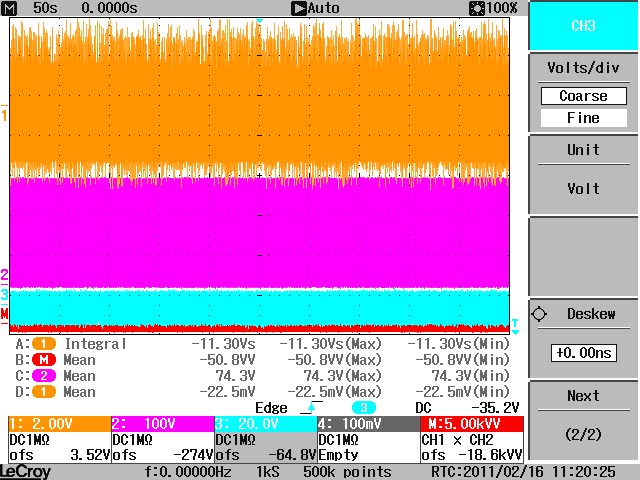
Here's a sight for sore eyes. Fifty seconds of pure magic in one fell swoop. Enjoy. Much more to follow - but this little doozy took a cool 18 minutes to upload. It needs framing.
Kindst regards,
Rosie

Here's a sight for sore eyes. Fifty seconds of pure magic in one fell swoop. Enjoy. Much more to follow - but this little doozy took a cool 18 minutes to upload. It needs framing.
Kindst regards,
Rosie
Subscribe to:
Posts (Atom)