Dear Reader,
For those of you who are into this kind of thing - here's my LOGIC to justify the magnetic dipole. Let me know if there's an error. I'm using a variation of this for our second paper.
Faraday proposed that magnetic fields are structured along lines of force. The voltage across a magnet or an induced magnetic field has two distinct poles or charges. Therefore lines of force also have two distinct charges. This field condition can be sustained if there is a further proposal made that the lines of force comprise magnetic dipoles, as this would satisfy the required 180-degree alignment of those lines of force. Current is widely ascribed to the movement of charge and it is known to induce electromotive force on circuit material. Electromotive force is measured as potential difference or voltage. And voltage, in turn, is a measure of an imbalance where the negative and positive charges are separated at the terminals of a supply source or across circuit components including the wire. This negative and positive charge imbalance is reduced, proportional to the rate of current flow. As electromotive force is known to be proportional to the rate of change of magnetic flux, and as current flow is proportional to the rate of change of the electromotive force then it may be proposed that both voltage and current flow may have this material magnetic property. Therefore, both current and voltage can, in turn, be modeled along Faraday’s lines of force. Current flow would then vary the distribution of that material throughout a circuit, which would then result in a redistribution of charge. In effect, a magnetic field in a condition of voltage imbalance, would be in a dynamic condition to redistribute that charge provided it is able to generate current flow through circuit material in order to enable that redistribution
Saturday, July 2, 2011
Wednesday, June 15, 2011
126 - submission around the corner
Dear Reader,
I'm holding back on submission to hear some comments from someone who has kindly offered to read our efforts. When that's to hand I'll correct - if and as required and then send it in.
It's decidedly my last efforts here. I am utterly disheartened by the absurdly inadequate critiques that have followed on from my report that was distributed to the most of our SA academics. The one study that was offered proposed that the simulation be modified to AVERAGE the battery voltage. That's an absurd proposal for so many reasons. The battery voltage is NEVER stable during the oscillation phase. It's a veritable roller-coaster. And no-one has picked up on the significance of that anti phase relationship between the battery and the shunt voltages. They're weird. Just to re-cap for those who are following this - here's the thing.
The battery discharges from a current flow that is measured above zero. Correspondingly it recharges from a current flow that is measured below zero. The conventional 'take' is that above zero the flow is clockwise. Below zero the flow is anti clockwise. So. What does one then do with our own evidence - both in the measured voltages and in the simulations. Because the above zero, clockwise current flow results in a REDUCTION of the battery voltage. And the below zero anti clockwise current flow results in an INCREASE in the battery voltage. It's quite literally back to front - upside down.
What's needed here is such a profound revision to the thinking of current flow and its properties that there's going to be a howl of protest. Any editor who is brave enough to publish is DEFINITELY going to need some caveat to justify it as - the content cannot be evaluated against prior work. There are no CITATIONS applicable. And the 'due diligence' from any reviewers if it even gets that far - will need to be confined to the evidence of simulations - which is hardly satisfactory. But it should help.
And then I have found - to my horror - that the level of expertise amongst some otherwise skilled engineers - is entirely lacking when it comes to the evaluation of what I would have thought was rather elementary power analysis. There seems to be a kind of mismash of confusing terms and confused concepts and utterly absurd equations. For some reason - everyone seems to think they can change the established protocols to just about anything they require. Poynty, for example, has seriously proposed that since one can expect the battery to 'discharge' it's enough to ASSUME that it is discharging. Under usual conditions it may show a ripple. Therefore, all that is needed is to disregard the ripple and assume a 'FLAT LINE'? Some easy and utterly illogical steps that have no bearing on anything experimentally evident. And that averaging of the battery voltage is then seriously proposed to be multiplied by amperage of the shunt in real time. So. It's not evident. It's INCORRECT protocols. So? Why then use it?
The answer is obvious. It's the only route left to FUDGE the evidence. It takes the attention away from that glaring anomaly of a battery's voltage climbing HUGELY in the process of delivering a really strong current flow. And by the same token it takes away the advantage of the reducing battery voltage precisely while the amperage is climbing in what is expected to result in a reduction in that voltage. A product of this in real time would INEVITABLY be to the benefit of a retained potential difference at the supply - to that COP infinity - that we keep referencing.
But I've now been in some discussion with some really clever academics. It's no accident that they also gravitate to the better universities. A real pleasure to see the questing mind. It's rare. And more to the point - when it can finally get to that forum - which it will do if it's published - then I'm reasonably certain that these questions will get 'sorted'. It needs mathematical clarification. And that is way beyond our own capabilities.
So. A few more days and we'll submit. Hopefully there's enough evidence to justify publication. Because, after all, it's the experimental evidence that - in fact - determines our science.
Kindest regards,
Rosemary
Just some doggerel for the amusement.
If philosophy is logical
And logic mathematical
Then the argument that follows this would be
That philosophy is measurable
Quantifiably numerical
And all determined unequivocally
While numbers metaphysical
Would then become nonsensical
A gross dimensional absurdity.
While these thoughts are just conceptual
It may perhaps be practical
To twine these branches from a single tree
Of knowledge. And though questionable
It may yet be more than reasonable
To let the thought conceive reality.
I'm holding back on submission to hear some comments from someone who has kindly offered to read our efforts. When that's to hand I'll correct - if and as required and then send it in.
It's decidedly my last efforts here. I am utterly disheartened by the absurdly inadequate critiques that have followed on from my report that was distributed to the most of our SA academics. The one study that was offered proposed that the simulation be modified to AVERAGE the battery voltage. That's an absurd proposal for so many reasons. The battery voltage is NEVER stable during the oscillation phase. It's a veritable roller-coaster. And no-one has picked up on the significance of that anti phase relationship between the battery and the shunt voltages. They're weird. Just to re-cap for those who are following this - here's the thing.
The battery discharges from a current flow that is measured above zero. Correspondingly it recharges from a current flow that is measured below zero. The conventional 'take' is that above zero the flow is clockwise. Below zero the flow is anti clockwise. So. What does one then do with our own evidence - both in the measured voltages and in the simulations. Because the above zero, clockwise current flow results in a REDUCTION of the battery voltage. And the below zero anti clockwise current flow results in an INCREASE in the battery voltage. It's quite literally back to front - upside down.
What's needed here is such a profound revision to the thinking of current flow and its properties that there's going to be a howl of protest. Any editor who is brave enough to publish is DEFINITELY going to need some caveat to justify it as - the content cannot be evaluated against prior work. There are no CITATIONS applicable. And the 'due diligence' from any reviewers if it even gets that far - will need to be confined to the evidence of simulations - which is hardly satisfactory. But it should help.
And then I have found - to my horror - that the level of expertise amongst some otherwise skilled engineers - is entirely lacking when it comes to the evaluation of what I would have thought was rather elementary power analysis. There seems to be a kind of mismash of confusing terms and confused concepts and utterly absurd equations. For some reason - everyone seems to think they can change the established protocols to just about anything they require. Poynty, for example, has seriously proposed that since one can expect the battery to 'discharge' it's enough to ASSUME that it is discharging. Under usual conditions it may show a ripple. Therefore, all that is needed is to disregard the ripple and assume a 'FLAT LINE'? Some easy and utterly illogical steps that have no bearing on anything experimentally evident. And that averaging of the battery voltage is then seriously proposed to be multiplied by amperage of the shunt in real time. So. It's not evident. It's INCORRECT protocols. So? Why then use it?
The answer is obvious. It's the only route left to FUDGE the evidence. It takes the attention away from that glaring anomaly of a battery's voltage climbing HUGELY in the process of delivering a really strong current flow. And by the same token it takes away the advantage of the reducing battery voltage precisely while the amperage is climbing in what is expected to result in a reduction in that voltage. A product of this in real time would INEVITABLY be to the benefit of a retained potential difference at the supply - to that COP infinity - that we keep referencing.
But I've now been in some discussion with some really clever academics. It's no accident that they also gravitate to the better universities. A real pleasure to see the questing mind. It's rare. And more to the point - when it can finally get to that forum - which it will do if it's published - then I'm reasonably certain that these questions will get 'sorted'. It needs mathematical clarification. And that is way beyond our own capabilities.
So. A few more days and we'll submit. Hopefully there's enough evidence to justify publication. Because, after all, it's the experimental evidence that - in fact - determines our science.
Kindest regards,
Rosemary
Just some doggerel for the amusement.
If philosophy is logical
And logic mathematical
Then the argument that follows this would be
That philosophy is measurable
Quantifiably numerical
And all determined unequivocally
While numbers metaphysical
Would then become nonsensical
A gross dimensional absurdity.
While these thoughts are just conceptual
It may perhaps be practical
To twine these branches from a single tree
Of knowledge. And though questionable
It may yet be more than reasonable
To let the thought conceive reality.


Tuesday, June 7, 2011
125 - just for the record
Dear Reader,
I've finally 'run out of space' on my computer. I need to clean out a lot of work and am simply making due record of it here before deleting it.
Please don't bother to reader here unless you're that interested.
Kindest regards,
Rosemary
REPORT ON A NEW DISCOVERY RELATED TO ENERGY AND THE APPLICATION OF ENERGY
1
A little about the background and problems related to the structures available to progress new discoveries.
It is evident that a simple switching circuit is able to dissipate more heat at a load than the amount of energy supplied by a battery supply source. This was first recorded in an article published in the October edition of Quantum magazine in 2002 – and subsequently widely reported on the internet in a test replication completed at the end of 2009. Both tests gave evidence of a co-efficient of performance in excess of 1, the first by a factor of 17 and the second by a factor of 7.
The essential design of both tests was a simple battery supply source placed in series with an inductive resistive load and a MOSFET transistor driven by a 555 circuit. Measurements were confined to a calorimetric evaluation of the energy dissipated at the load compared to a control. And the measure of the energy delivered by the battery supply was based on the voltage measured across a non-inductive shunt resistor placed in series with the negative rail of the battery to determine the rate of current flow.
The question is why either test generated so little public interest given the extraordinary nature of the claim? The reason for this is that our application to publish in a reviewed journal was denied. The rejection of the first paper may possibly have been excused on the bases of insufficient data and possible inadequacy of the measuring instruments used. But the second paper detailing these results rather erred on the side of excess. And the instrument that recorded this data was a Tektronix TDS3054C that was more than adequate both in terms of its rated bandwidth and the sophistication of the software that enables due record.
The actual reasons given for the rejection of the second paper, even prior to review, was that the technology was based on a thesis that was outside the expertise of the reviewers. The suggestion was made that it would, therefore, be more appropriate for publication in a physics journal. But, in as much as electrical measurement falls outside the expertise of our physicists, it seems that the paper may forever remain profoundly and fundamentally unpublishable. In the light of the extraordinary nature of the claim one hopes not. The more so as the results show a technological potential that may address those manifold concerns related to pollution. These concerns dog our burgeoning energy needs and our somewhat profligate use of this.
The fact is that our Thermodynamic Laws are that entrenched in our general and mainstream physics paradigms that it is now entirely impossible to give a reasonable account of breach of this through any respectable medium whatsoever. Claims of breach are met with rank scepticism and dismissed on the basis of ‘assumption of error’. And all solicitations, to either attend a demonstration or to comment after such attendance, were only ever met with a blunt refusal accompanied by a parade of contempt and condescension. And it is unlikely that such an attitude can be considered appropriate to science. Science is only ever progressed through experimental evidence. To deny that evidence, or more appropriately, the careful evaluation of that evidence, serves nothing but prejudice. And neither prejudice nor assumption can ever serve the truth.
As it applies to an evaluation of our own experimental evidence, this less than satisfactory attitude is entirely unacceptable. The circuit is simple. The component parts are easily identifiable. The measurements are instantaneously available subject only to the use of an appropriate oscilloscope. And to compare each and every aspect of the test claim as it relates to the dissipation of heat against a control, then a short half hour would suffice. To refute the claim would take a matter of minutes for any expert qualified in power engineering. The numbers are neither elusive nor marginal. The results are unambiguous and repeatable. And they consistently point to a breach in Thermodynamic constraints that merits considerably more attention than they have actually, historically managed.
As mentioned, the review process allows publication of experimental evidence that interested parties can then evaluate the experiment to progress it or to use it as required. But, historically, this progress has been confined to incremental improvements and small variations where results remain substantially within thermodynamic constraints. The only vehicle available for publication of results that defy these limitations are through Open Source and the internet.
But herein lies a second danger that rather exceeds the risk of test evidence being merely overlooked. Internet communication is by individuals who, more often than not, hide behind an avatar or an assumed identity. There is an overriding lack of accountability and, not being accountable allows contributors the freedom of expression that is as unrestrained as ‘road rage’ and often as destructive. Opinion, unsubstantiated allegation, calumny and rank unprofessionalism abound. Technology is promoted or destroyed with far less effort and far less merit than the carefully composed chapters of those many papers submitted through traditional channels. And where claims of unity breach are actively encouraged through multiple forums they are also as readily dismissed due to the flagrantly self-serving opinions of those many who subscribe. While the facts of any issue are recorded for posterity, the memory of its readers and contributors is short. Open source is indeed vulnerable to gross and even to criminal abuse. And it can, therefore never be considered a reasonable alternative to progress new knowledge.
In conclusion therefore, it is evident that there is no vehicle, no procedural blue print, where new thinking and new discoveries can be appropriately addressed. Scientific merit is only ever attributed within the tight confines of popular opinion be it learned or otherwise - be it through the channels of academic publication or through free internet publication. Either way is fraught. The hope here is to forge some system, some method that can breach these barriers. The thinking now is that demonstrations should be limited to a prepared audience and that their subsequent evaluation carry the required accreditation to merit publication in a reviewed journal. Publication would then, hopefully, satisfy mainstream that the experiment requires fuller research. There is more than enough experimental proof to of concept. What is now required is that these tests be put up at multiple benches through many different laboratories and institutions that the full extent of the claim can be carefully evaluated and verified or refuted as that knowledge grows.
References
Reference 1 - http://newlightondarkenergy.blogspot.com/2010/12/finally-our-tie-paper.html
I've finally 'run out of space' on my computer. I need to clean out a lot of work and am simply making due record of it here before deleting it.
Please don't bother to reader here unless you're that interested.
Kindest regards,
Rosemary
REPORT ON A NEW DISCOVERY RELATED TO ENERGY AND THE APPLICATION OF ENERGY
1
A little about the background and problems related to the structures available to progress new discoveries.
It is evident that a simple switching circuit is able to dissipate more heat at a load than the amount of energy supplied by a battery supply source. This was first recorded in an article published in the October edition of Quantum magazine in 2002 – and subsequently widely reported on the internet in a test replication completed at the end of 2009. Both tests gave evidence of a co-efficient of performance in excess of 1, the first by a factor of 17 and the second by a factor of 7.
The essential design of both tests was a simple battery supply source placed in series with an inductive resistive load and a MOSFET transistor driven by a 555 circuit. Measurements were confined to a calorimetric evaluation of the energy dissipated at the load compared to a control. And the measure of the energy delivered by the battery supply was based on the voltage measured across a non-inductive shunt resistor placed in series with the negative rail of the battery to determine the rate of current flow.
The question is why either test generated so little public interest given the extraordinary nature of the claim? The reason for this is that our application to publish in a reviewed journal was denied. The rejection of the first paper may possibly have been excused on the bases of insufficient data and possible inadequacy of the measuring instruments used. But the second paper detailing these results rather erred on the side of excess. And the instrument that recorded this data was a Tektronix TDS3054C that was more than adequate both in terms of its rated bandwidth and the sophistication of the software that enables due record.
The actual reasons given for the rejection of the second paper, even prior to review, was that the technology was based on a thesis that was outside the expertise of the reviewers. The suggestion was made that it would, therefore, be more appropriate for publication in a physics journal. But, in as much as electrical measurement falls outside the expertise of our physicists, it seems that the paper may forever remain profoundly and fundamentally unpublishable. In the light of the extraordinary nature of the claim one hopes not. The more so as the results show a technological potential that may address those manifold concerns related to pollution. These concerns dog our burgeoning energy needs and our somewhat profligate use of this.
The fact is that our Thermodynamic Laws are that entrenched in our general and mainstream physics paradigms that it is now entirely impossible to give a reasonable account of breach of this through any respectable medium whatsoever. Claims of breach are met with rank scepticism and dismissed on the basis of ‘assumption of error’. And all solicitations, to either attend a demonstration or to comment after such attendance, were only ever met with a blunt refusal accompanied by a parade of contempt and condescension. And it is unlikely that such an attitude can be considered appropriate to science. Science is only ever progressed through experimental evidence. To deny that evidence, or more appropriately, the careful evaluation of that evidence, serves nothing but prejudice. And neither prejudice nor assumption can ever serve the truth.
As it applies to an evaluation of our own experimental evidence, this less than satisfactory attitude is entirely unacceptable. The circuit is simple. The component parts are easily identifiable. The measurements are instantaneously available subject only to the use of an appropriate oscilloscope. And to compare each and every aspect of the test claim as it relates to the dissipation of heat against a control, then a short half hour would suffice. To refute the claim would take a matter of minutes for any expert qualified in power engineering. The numbers are neither elusive nor marginal. The results are unambiguous and repeatable. And they consistently point to a breach in Thermodynamic constraints that merits considerably more attention than they have actually, historically managed.
As mentioned, the review process allows publication of experimental evidence that interested parties can then evaluate the experiment to progress it or to use it as required. But, historically, this progress has been confined to incremental improvements and small variations where results remain substantially within thermodynamic constraints. The only vehicle available for publication of results that defy these limitations are through Open Source and the internet.
But herein lies a second danger that rather exceeds the risk of test evidence being merely overlooked. Internet communication is by individuals who, more often than not, hide behind an avatar or an assumed identity. There is an overriding lack of accountability and, not being accountable allows contributors the freedom of expression that is as unrestrained as ‘road rage’ and often as destructive. Opinion, unsubstantiated allegation, calumny and rank unprofessionalism abound. Technology is promoted or destroyed with far less effort and far less merit than the carefully composed chapters of those many papers submitted through traditional channels. And where claims of unity breach are actively encouraged through multiple forums they are also as readily dismissed due to the flagrantly self-serving opinions of those many who subscribe. While the facts of any issue are recorded for posterity, the memory of its readers and contributors is short. Open source is indeed vulnerable to gross and even to criminal abuse. And it can, therefore never be considered a reasonable alternative to progress new knowledge.
In conclusion therefore, it is evident that there is no vehicle, no procedural blue print, where new thinking and new discoveries can be appropriately addressed. Scientific merit is only ever attributed within the tight confines of popular opinion be it learned or otherwise - be it through the channels of academic publication or through free internet publication. Either way is fraught. The hope here is to forge some system, some method that can breach these barriers. The thinking now is that demonstrations should be limited to a prepared audience and that their subsequent evaluation carry the required accreditation to merit publication in a reviewed journal. Publication would then, hopefully, satisfy mainstream that the experiment requires fuller research. There is more than enough experimental proof to of concept. What is now required is that these tests be put up at multiple benches through many different laboratories and institutions that the full extent of the claim can be carefully evaluated and verified or refuted as that knowledge grows.
References
Reference 1 - http://newlightondarkenergy.blogspot.com/2010/12/finally-our-tie-paper.html
124 - hope springs eternal
Dear Reader,
We're nearly there. I'm still struggling with the introduction to the paper - but that's only because I'm trying to get it simplified yet comprehensive. No easy task. I know now that the battle with our trolls is nearly over. A few coming forward with the occasional blunt swipe - but their arguments are stale and grounded in gross misconception.
When I look back at all those posts and all those objections - I feel I've climbed Everest - four or five times - only to reach the precipice to tumble down again. But this time I think we've forged a better path through all those previous climbs. Certainly it's one that others can now walk - without getting altitude sickness - or vertigo.
Whatever happens - published or not - these experimental results are profoundly significant. And I think they'll survive me - as required - if they're to be advanced. And that's all thanks to the internet. It is a sad truth that there is very little support for these findings - most significantly lacking by our 'free energy enthusiasts'. One would have expected them to rally. But the news is not palatable when it's advanced by an old woman - least of all one who is untrained. I think the hope or expectation was that such exciting news should have been advanced by someone with charisma - another Tesla. So. What can I say? And the most of those members do their own experiments within the constraints of budgets and available testing equipment. And to disclose the full benefit here one actually needs the super sophisticated measuring tools that I have been privileged to use. It is a truth that if our paper is published - then our instrument manufacturers will have to up the anti in their software to let these facts be more readily accessible.
Anyway - our target for submission is mid month. Everyone's rallying. And it's all good news. I have cautious reason to expect a genuine investigation by our reviewers - which will be a first. And I think the evidence will now be considered on its own merits. Which is a very good thing. I'm afraid that our South African academics have still not rallied. Perhaps that'll change prior to publication. One can only hope.
Kind regards
Rosemary
We're nearly there. I'm still struggling with the introduction to the paper - but that's only because I'm trying to get it simplified yet comprehensive. No easy task. I know now that the battle with our trolls is nearly over. A few coming forward with the occasional blunt swipe - but their arguments are stale and grounded in gross misconception.
When I look back at all those posts and all those objections - I feel I've climbed Everest - four or five times - only to reach the precipice to tumble down again. But this time I think we've forged a better path through all those previous climbs. Certainly it's one that others can now walk - without getting altitude sickness - or vertigo.
Whatever happens - published or not - these experimental results are profoundly significant. And I think they'll survive me - as required - if they're to be advanced. And that's all thanks to the internet. It is a sad truth that there is very little support for these findings - most significantly lacking by our 'free energy enthusiasts'. One would have expected them to rally. But the news is not palatable when it's advanced by an old woman - least of all one who is untrained. I think the hope or expectation was that such exciting news should have been advanced by someone with charisma - another Tesla. So. What can I say? And the most of those members do their own experiments within the constraints of budgets and available testing equipment. And to disclose the full benefit here one actually needs the super sophisticated measuring tools that I have been privileged to use. It is a truth that if our paper is published - then our instrument manufacturers will have to up the anti in their software to let these facts be more readily accessible.
Anyway - our target for submission is mid month. Everyone's rallying. And it's all good news. I have cautious reason to expect a genuine investigation by our reviewers - which will be a first. And I think the evidence will now be considered on its own merits. Which is a very good thing. I'm afraid that our South African academics have still not rallied. Perhaps that'll change prior to publication. One can only hope.
Kind regards
Rosemary
Monday, May 30, 2011
123 - the cover letter to be circulated with the revised report
Dear Reader,
The following is the letter that will now be circulated to all the major academies in England together with the revised report.
FROM
Rosemary Ainslie
Donovan Martin
Mario Human
Evan Robinson
Alan Macey
Dear Professor
MEASURED BREACH OF THERMODYNAMIC CONSTRAINTS IN A SIMPLE SWITCHING CIRCUIT RESULTING IN AN INFINITE CO-EFFICIENT OF PERFORMANCE
Between 2001 and 2002, a co-efficient of performance (COP) greater than 1 was measured on various configurations of the circuit apparatus that is referred to in the attached report. These results were witnessed and accredited by many companies including BP (SA), ABB Research (NC USA), POWER ENGINEERING (SA), (a subsidiary of ALSTOM), CSIR (SA) and SASOL (SA). SASOL also offered UCT a scholarship to take this study further. That offer was declined. With the exception of Power Engineers, all those companies allowed their names to be referenced as accrediting authorities in a paper that was published in the October 2002 edition of Quantum Magazine. That publication detailed the experimental evidence of COP>17. This research has now progressed where a variation of the transistor configurations now results in measurements of an infinite COP. The attached report refers.
It is an incontestable truth that science can only be progressed by experimental evidence. And where a claim confronts mainstream prediction then such experimental evidence is essential. Standard protocols require the publication of a paper detailing the test and its results in a reviewed journal. Then subscribing experts can evaluate the paper and any claims related to those experiments. But it is also an unfortunate reality that - notwithstanding repeated efforts to publish - all submissions resulted in outright rejection of that paper, even prior to review of the paper itself. This prescriptive editorial comment has mitigated against the academic advancement of this technology over a period of 10 years including 5 separate submission attempts. In the light of our escalating global energy crisis it may, possibly, be considered an inappropriate response. The more so as each submission included greater measurement accuracy and, latterly, even more compelling experimental evidence.
A second route to the advancement of contentious science would be public demonstration of the experiment and its results. To this end and in a further effort to promote this technology, electrical engineering experts from all the major universities in South Africa, were invited to a public demonstration held on the 12th March, 2011 at Cape Peninsular University of Technology, Cape Town, South Africa. The intention of that demonstration was to show these latest results of a unity breach in the transfer of electric energy more fully detailed in the attached report. This has also failed because, unhappily none of the invited experts attended that demonstration. Because of this, an eccentric transistor configuration was not fully disclosed at that demonstration. A full disclosure is now incorporated in the attached revised report. There have been repeated solicitations to all our South African academic experts, spanning a period of 10 years, to evaluate the experimental results for themselves. No academic has been prepared to both attend a demonstration and, or comment.
In order to circumvent any further interventions by Journal editorial staff and to promote a wide dissemination of these results, we are now forwarding the report of this experiment to a wide range of academies including your own. This will be followed by yet another paper submission that - if it is also rejected - will be open sourced on-line. We would appeal to all experts in related fields to simulate the results contained in this report or to replicate the experiment, as preferred. If there are any hidden flaws to the argument then this can be resolved through that evidence. The intention here is to advance this experimental evidence to a wide range of experts that the subject may then garner the close scrutiny and overview that it so clearly requires.
While the results themselves confront mainstream prediction it is clearly allowed within classical paradigms as the results can be replicated experimentally as well as simulated on software programs. The results were predicted in a thesis related to a non-classical magnetic field model. They point to the fact that Kirchhoff’s requirements for equivalence, in the transfer of electric energy, does not take the potentials of inductive and conductive circuit components into consideration. This would, nonetheless, be required in terms of Einstein’s mass energy equivalences. The test results indicate that inductive laws do, indeed, release this potential that the circuit material effectively becomes a second energy supply source. This potential has not, hitherto, been factored into our standard electrical applications.
This technology has been widely disclosed in the public domain and is, therefore, not patentable.
Kind regards,
Rosemary Ainslie
On behalf of New Energy Research Development
The following is the letter that will now be circulated to all the major academies in England together with the revised report.
FROM
Rosemary Ainslie
Donovan Martin
Mario Human
Evan Robinson
Alan Macey
Dear Professor
MEASURED BREACH OF THERMODYNAMIC CONSTRAINTS IN A SIMPLE SWITCHING CIRCUIT RESULTING IN AN INFINITE CO-EFFICIENT OF PERFORMANCE
Between 2001 and 2002, a co-efficient of performance (COP) greater than 1 was measured on various configurations of the circuit apparatus that is referred to in the attached report. These results were witnessed and accredited by many companies including BP (SA), ABB Research (NC USA), POWER ENGINEERING (SA), (a subsidiary of ALSTOM), CSIR (SA) and SASOL (SA). SASOL also offered UCT a scholarship to take this study further. That offer was declined. With the exception of Power Engineers, all those companies allowed their names to be referenced as accrediting authorities in a paper that was published in the October 2002 edition of Quantum Magazine. That publication detailed the experimental evidence of COP>17. This research has now progressed where a variation of the transistor configurations now results in measurements of an infinite COP. The attached report refers.
It is an incontestable truth that science can only be progressed by experimental evidence. And where a claim confronts mainstream prediction then such experimental evidence is essential. Standard protocols require the publication of a paper detailing the test and its results in a reviewed journal. Then subscribing experts can evaluate the paper and any claims related to those experiments. But it is also an unfortunate reality that - notwithstanding repeated efforts to publish - all submissions resulted in outright rejection of that paper, even prior to review of the paper itself. This prescriptive editorial comment has mitigated against the academic advancement of this technology over a period of 10 years including 5 separate submission attempts. In the light of our escalating global energy crisis it may, possibly, be considered an inappropriate response. The more so as each submission included greater measurement accuracy and, latterly, even more compelling experimental evidence.
A second route to the advancement of contentious science would be public demonstration of the experiment and its results. To this end and in a further effort to promote this technology, electrical engineering experts from all the major universities in South Africa, were invited to a public demonstration held on the 12th March, 2011 at Cape Peninsular University of Technology, Cape Town, South Africa. The intention of that demonstration was to show these latest results of a unity breach in the transfer of electric energy more fully detailed in the attached report. This has also failed because, unhappily none of the invited experts attended that demonstration. Because of this, an eccentric transistor configuration was not fully disclosed at that demonstration. A full disclosure is now incorporated in the attached revised report. There have been repeated solicitations to all our South African academic experts, spanning a period of 10 years, to evaluate the experimental results for themselves. No academic has been prepared to both attend a demonstration and, or comment.
In order to circumvent any further interventions by Journal editorial staff and to promote a wide dissemination of these results, we are now forwarding the report of this experiment to a wide range of academies including your own. This will be followed by yet another paper submission that - if it is also rejected - will be open sourced on-line. We would appeal to all experts in related fields to simulate the results contained in this report or to replicate the experiment, as preferred. If there are any hidden flaws to the argument then this can be resolved through that evidence. The intention here is to advance this experimental evidence to a wide range of experts that the subject may then garner the close scrutiny and overview that it so clearly requires.
While the results themselves confront mainstream prediction it is clearly allowed within classical paradigms as the results can be replicated experimentally as well as simulated on software programs. The results were predicted in a thesis related to a non-classical magnetic field model. They point to the fact that Kirchhoff’s requirements for equivalence, in the transfer of electric energy, does not take the potentials of inductive and conductive circuit components into consideration. This would, nonetheless, be required in terms of Einstein’s mass energy equivalences. The test results indicate that inductive laws do, indeed, release this potential that the circuit material effectively becomes a second energy supply source. This potential has not, hitherto, been factored into our standard electrical applications.
This technology has been widely disclosed in the public domain and is, therefore, not patentable.
Kind regards,
Rosemary Ainslie
On behalf of New Energy Research Development
Tuesday, May 24, 2011
122 - what gives?
Dear Reader,
I had to get my pc cleaned and one of my apples. That was hardly a week ago. Now it seems that they've both been hacked. But this time it's selective viewing. I can get into here - my blogspot - and just about anywhere I want to on the internet. But I can't get into any of the forums?
It's a sad truth that these claims of ours seem to need silencing. And that's not likely to happen unless or until I'm dead.
Meanwhile - more good news. I've had word of yet another successful simulation also showing a net gain to the supply source. Negative wattage values. Golly. That's a new event in science and will somehow have to be 'factored in'. Just needs some kind of acceptable description. Negative wattage doesn't cut it somehow.
In any event - here's the thing. Tell your friends, challenge your academics to try this on PSpice or any software that they've got going. The truth, as I keep saying, is that IF this can be simulated - if indeed it is possible to show that more energy can be returned to the supply than delivered - then we've cracked the evidence through the most readily available tool. We can get rid of our experimental apparatus and just start designing those MUCH NEEDED applications.
And this s for Tivon. Your latest ideas are simply breathtaking. I would love to learn more as you progress.
It's a very good thing.
Kindest regards,
Rosemary
I had to get my pc cleaned and one of my apples. That was hardly a week ago. Now it seems that they've both been hacked. But this time it's selective viewing. I can get into here - my blogspot - and just about anywhere I want to on the internet. But I can't get into any of the forums?
It's a sad truth that these claims of ours seem to need silencing. And that's not likely to happen unless or until I'm dead.
Meanwhile - more good news. I've had word of yet another successful simulation also showing a net gain to the supply source. Negative wattage values. Golly. That's a new event in science and will somehow have to be 'factored in'. Just needs some kind of acceptable description. Negative wattage doesn't cut it somehow.
In any event - here's the thing. Tell your friends, challenge your academics to try this on PSpice or any software that they've got going. The truth, as I keep saying, is that IF this can be simulated - if indeed it is possible to show that more energy can be returned to the supply than delivered - then we've cracked the evidence through the most readily available tool. We can get rid of our experimental apparatus and just start designing those MUCH NEEDED applications.
And this s for Tivon. Your latest ideas are simply breathtaking. I would love to learn more as you progress.
It's a very good thing.
Kindest regards,
Rosemary
Monday, May 23, 2011
121 - simulations
Dear Reader,
I've FINALLY learned how to work in 'draft' format. lol. I've removed my current analysis accordingly.
The efficiency of our circuit technology is very well explained by the oscillation that is enabled through the that eccentric NERD Q-Array. What this manages to do is to control the input current at a predetermined frequency while allowing the full expression and potential benefits of that parasitic oscillation. This is generally 'blocked' in standard applications as being unnecessary. In our case we rely on this oscillation to generate usable heat over the resistor element - while doing nothing material to deplete the energy from the battery supply source.
Surprisingly - this oscillation is allowed for in standard simulation software. This fact is hugely significant. It means that, in effect, one can explore and develop this technology as a primary tool and use apparatus to simply verify those results. This - indeed - is why that software was ever developed. The surprise is this. The software itself has no 'restrictions' to showing results that exceed Kirchhoff's rules. In effect there is an implicit requirement in the computation of power delivered and dissipated that relies on Faraday's Inductive Laws to the exclusion of any Thermodynamic restrictions at all. It is tailored, in effect, to show Over Unity - should this be a consequence of a circuit design.
That fact is EXTRAORDINARY. I have been ASSURED that if this proves correct - then one can move away from the experimental apparatus and simply explore the applications as designed on this software. Subsequent testing would be secondary. It frees up the potentials for design - exponentially. WHICH IS A VERY GOOD THING.
I am in receipt of some excellent work done by Tivon Rivers confined to the use of a 555 switching circuit. What he found is that the voltage and subsequent current flow - actually varies over time that the power on the circuit gradually increases. But his results do not, yet appear to show Over Unity. I am also aware of some other work that is being done here but have not yet been given those results. Meanwhile, however, here's Poynty's results as they relate to our own circuit.
ENJOY.
Kindest regards,
Rosie


I've FINALLY learned how to work in 'draft' format. lol. I've removed my current analysis accordingly.
The efficiency of our circuit technology is very well explained by the oscillation that is enabled through the that eccentric NERD Q-Array. What this manages to do is to control the input current at a predetermined frequency while allowing the full expression and potential benefits of that parasitic oscillation. This is generally 'blocked' in standard applications as being unnecessary. In our case we rely on this oscillation to generate usable heat over the resistor element - while doing nothing material to deplete the energy from the battery supply source.
Surprisingly - this oscillation is allowed for in standard simulation software. This fact is hugely significant. It means that, in effect, one can explore and develop this technology as a primary tool and use apparatus to simply verify those results. This - indeed - is why that software was ever developed. The surprise is this. The software itself has no 'restrictions' to showing results that exceed Kirchhoff's rules. In effect there is an implicit requirement in the computation of power delivered and dissipated that relies on Faraday's Inductive Laws to the exclusion of any Thermodynamic restrictions at all. It is tailored, in effect, to show Over Unity - should this be a consequence of a circuit design.
That fact is EXTRAORDINARY. I have been ASSURED that if this proves correct - then one can move away from the experimental apparatus and simply explore the applications as designed on this software. Subsequent testing would be secondary. It frees up the potentials for design - exponentially. WHICH IS A VERY GOOD THING.
I am in receipt of some excellent work done by Tivon Rivers confined to the use of a 555 switching circuit. What he found is that the voltage and subsequent current flow - actually varies over time that the power on the circuit gradually increases. But his results do not, yet appear to show Over Unity. I am also aware of some other work that is being done here but have not yet been given those results. Meanwhile, however, here's Poynty's results as they relate to our own circuit.
ENJOY.
Kindest regards,
Rosie


Thursday, May 19, 2011
120 - revised report
Dear Reader,
The following is a download of the revised report incorporating that eccentric 'Q-array' that is responsible for the robust oscillation that is required for the efficiency of this applied circuit technology.
REPORT ON TWO TESTS OF A SWITCHING CIRCUIT FOR DEMONSTRATION AT CPUT on 12TH MARCH 2011.
Prepared by Rosemary Ainslie, Donovan Martin, Evan Robinson, Mario Human.
The following tests performed prior to the demonstration and then demonstrated at a demonstration held at CPUT on the 12th March, 2011. The tests were designed to evaluate some aspects of a thesis that predicts a potential for the conservation of potential difference at a supply. This thesis is based on a non-classical magnetic field model and what is demonstrated here is a non-conservative field condition on a circuit, as required by that model. While this may confront Kirchhoff’s Laws, the experimental results are in line with Faraday’s Laws of Induction. This may suggest that Inductive Laws supersede the conservative field requirements. It is proposed, therefore, that the results are in line with classical requirements albeit that they seemingly contradict the results determined by the Second Law of Thermodynamics.
1 FIRST TEST
1.1 Circuit description
The experimental apparatus comprises a simple switching circuit (see Figure 1). 6 x 12 volt lead acid batteries are in series with both a heating element (RL1) and 5 MOSFET transistors (Q1) in parallel. The transistors are driven by a functions generator. A current sensing resistor (Rshunt) on the source rail of the supply determines the rate of current flow both to and from the battery supply source.

Fig 1: First test circuit schematic including probe positions.
1.2 Schedule of circuit components
1.2.1 Resistor element RL1 - Incoloy alloy air heating rod element threaded with nichrome resistive wire. Resistance = 11.11Ω, L = 2.23μH. 200 watts. Supplied by Specific Heat
1.2.2 Current sensing resistor Rshunt - 4 ceramic wire wound 1 watt resistors 1Ω each, placed in parallel. Resistance therefore = 0.25Ω. L = 220nH
1.2.3 MOSFET transistor Q1 - 1 x IRFPG50 with Zener body diode
1.2.3 MOSFET transistor Q2 – 4 x IRFPG50 with Zener body diode
1.2.4 Function generator
1.2.5 6 x 12v batteries - Raylite silver calcium
1.3 Schedule of measuring instruments
1.3.1 Le Croy WaveJet 324 200 MHz Oscilloscope (DSO) - 2GS/s 400 Vpk tolerance. Sample range maximum 500 000 samples
1.3.2 Tektronix MSO 3054 Mixed Signal Oscilloscope (DSO) - 500 MHz 2.5 GS/s. Sample range maximum 1 million samples
1.3.3 FLUKE Digital Multimeter TopTronic T48 True RMS with thermocouple measuring to 400°C (rated at ±1%+4).
1.4 Circuit operation
The circuit is designed to allow a secondary current flow that is induced from the collapsing fields of RL1 during the OFF period of the duty cycle as a result of counter electromotive force (CEMF). This reverse current path is enabled by the body diode in the transistors as well as the eccentric positioning of MOSFETs (Q2) that are configured to enable a negative current flow driven by a negative charge applied to the Gate of Q2. This allows a current flow that returns to the battery supply source to recharge it. Small adjustments to the offset of the functions generator enables the generation of a ‘burst oscillation’ mode that is triggered when the gate voltage defaults below zero. This oscillation occurs at a naturally resonating frequency determined by the impedance of the circuit components. The adjustment to the offset also requires careful tuning to regulate the level of power required to be dissipated at the load. See Figure 3 for typical gate voltage setting.
1.5 Measurement of wattage dissipated
Measurement of the energy dissipated at the resistor element (RL1) was determined by comparison with results from a control to avoid the complexity of factoring in power factor corrections. A constant voltage was applied from a DC power supply source in series with RL1. The voltage was then steadily increased in increments of 1 volt each from 1 volt through to 22 volts. The wattage was then determined as the squared product of the voltage over the resistance of RL1,
The temperature of the resistor was then recorded against the applied wattage and the temperature difference above ambient determined the level of wattage as represented in Table 1 and Figure 2.


1.6 Measurement of wattage delivered by the battery supply
Power is calculated as vi. The flow of current (i) is determined by the voltage measured across Rshunt over the resistance of Rshunt.
(2)
Typically the battery supplies a direct current. Therefore, voltage that is measured above zero, is considered to result in a current flow delivered by the battery. And, conversely, voltage that is measured below zero is considered to result in a current flow delivered to the battery. The instantaneous wattage delivered to or by the battery is then determined as the product of the voltage across the batteries and the current.
2. SECOND TEST
2.1 Circuit description
The circuit is configured identically to the diagram in Figure 1 but with a reduction in the number of batteries applied to three, supplying approximately 36v. All other parameters are identical to the First Test.
2.2 Circuit operation
With a reduced supply voltage, the voltage across Rshunt increases, corresponding to the increase from the positive applied voltage signal from the gate during the ON period of the duty cycle and as determined by the offset. This results in an increase in current flow from the battery. This increase is commensurate with an increase in temperature rise that is measured to be dissipated on RL1. The rate of temperature rise depends on the offset adjustment and the applied source battery voltage during this ON time. At its highest setting, this results in an excess of 44 watts being dissipated. It has not been possible to test this to higher temperatures and for extended periods, as the there is a limit to the voltage tolerance of the DSOs.
2.3 Measurement of wattage dissipated at the load
The applied protocol is consistent with that described in 1.5 of Test 1.
2.4 Measurement of wattage delivered by the battery supply
The mean average and cycle mean average of the voltages measured across Rshunt now default to positive. Instantaneous wattage analsys is based on para 1.6 above.
3. RESULTS
3.1 First test
The temperature over RL1 indicates that about 6 watts is being dissipated as heat. However, the instantaneous wattage analysis indicates that more energy has been returned to the battery than has been supplied resulting in a net zero loss of potential difference from the supply. Of interest is that the mean and cycle mean average voltage across Rshunt are consistently negative.
More wattage returned to the battery than was delivered.
Wattage dissipated at RL1 = 6 watts.
Sustained periodic condition of oscillation enabled for 2.7 minutes to the limit of the intervals allowed by the function generator
3.2 Second test
The mean average and cycle mean average voltage across Rshunt indicates that some current has been discharged by the battery to the source rail. However, instantaneous wattage analysis applied to the voltage measured across the battery and Rshunt indicate, here too, that the battery supply source has had more energy returned to recharge it than was first applied to the circuit. When this is applied to each sample from a spreadsheet analysis across the 500 000 to 1 million samples supplied by the digital storage oscilloscopes, then the product of this and the battery voltage represents the instantaneous wattage. The sum of these values, divided by the number of samples, represents the average wattage delivered over the entire sample range. This results in a negative value indicating that more energy is still being returned to the battery than was delivered. This is in line with the math function of the DSOs where it, too, indicates an increase of wattage back to the battery supply over the amount of wattage initially delivered from that supply.
More wattage returned to the battery than was delivered
Wattage dissipated at RL1= 44 watts
Switching results in the generation of extreme spiking at the transitional phases of the switch.
4. ANOMALIES
4.1 It is understood that during the ON time the applied signal at the gate will enable a current flow from the battery supply. With the application of more than 36 volts from the battery supply, the circuit can be tuned so that there is no measured voltage or consequent flow of current through to the source rail of the supply during this ON period. The precise cause of this restriction has not been identified and requires further research. Nor can this condition be simulated.
4.2 When the offset of the function generator is adjusted (see Figure 3), the falling edge of the pulse results in a burst oscillation mode. Parasitic inductance is a well-known consequence of MOSFETs placed in parallel. It is undesirable for switching applications and is therefore, traditionally, factored out of the circuitry. On this application we have enabled that oscillation to the limit of the function generator’s slowest switching speed at 2.7 minutes or 6.172mHz. No material or evident variation or decay of that resonance throughout that entire period, is observed (see Figure 4). This results in a measured increase of recharge at the battery supply as well as sustaining the temperature over the resistor. It would be desirable to extend this period of oscillation to see whether decay in this oscillation, eventually takes place. These results may warrant further research, as the implications are that the current flow may be perpetuated through this self-oscillation.


4.3 Also apparent is that the oscillation is required to retain the temperature measured at the resistor at approximately 40°C above ambient. This temperature rise corresponds to a dissipation of approximately 6 watts at RL1 (according to Figure 2). The fact that it retains this heat is not a result of any unique properties to RL1 as the temperature is seen to fall steeply over a 3 minute period, when it is disconnected from the supply.
4.4 At these slowest switching speeds, at 6.172 mHz, and during that burst oscillation mode period where the frequency is measured at close to 1.5 MHz, the battery supply source is seen to recharge. The same oscillation amplitude is evident at all higher frequencies with the same attendant benefits.
4.5 The voltage across the shunt is at 180 degrees in anti phase with the voltage across the battery (Figure 5) and the voltage across the Drain (Figure 6). While this is repeatable in simulations it is not evident that the oscillations can be sustained at the same amplitudes over an extended period.


4.6 Typically, and as can be seen from the oscilloscope screen shots, it is possible to tune the circuit through adjustments to the offset and the duty cycle, to obtain a negative mean average and cycle mean average voltage measured at Rshunt. This indicates that there is more current being returned to the battery supply than was first delivered. This is confirmed by detailed analysis of data downloads to spreadsheets.
4.7 There is evidence of approximately 6 watts of energy dissipated at RL1, and upwards of 40 watts on Test 2, at no measurable cost of energy delivered from the supply. As this heat is not at the cost of energy from the supply it suggests that there is an alternate energy supply source or classical prediction errs in its assumption of equivalence in the transfer of energy.
4.8 Measurement of battery voltage was determined by the mean average voltage on the digital storage oscilloscopes, as well as from the digital multimeters, with probes placed directly on the positive and negative terminals of the battery supply. These battery voltages fluctuate in line with the evident voltage variations of the waveforms displayed. What is shown is that there is a recharge period after the discharge of current from the voltage during the ON period of the duty cycle. It is more clearly evident at the slowest switching speed. This indicates that there is a battery recharge during the period when the switch is in burst oscillation mode that occurs when the gate voltage is negative. Therefore is there evidence that the oscillations resulting from this negative triggering, are indeed recharging the battery.
5. SIMULATION
5.1 The circuit was setup in Simetrix version 5.4 (Figure 7) and simulated in correlation with the above tests (Figure 8).


6.DISCUSSION
The results of this demonstration are consistent with the previous reported test results related to this circuitry. The difference here is that there is an extended period of self-induced oscillation following the falling edge of the gate drive signal. This appears to enhance the circuit performance to what is now measured as what appears to be an infinite co-efficient of performance. This value has been carefully evaluated, but it is preferred that the circuit and all its effects be carefully established by experts.
Therefore the intention of this demonstration is to bring these anomalies to the academic forum so that experts can research these effects more thoroughly. There are many questions here that need answers and it is considered that this is best established across a broad range of research to establish the checks and balances required for the progress of this new technology.
It is an unfortunate fact that publication of these results in academic journals will first require some accreditation. Attempts to publish in reviewed journals were denied, even prior to review of the submitted papers. Although not admitted, the indications are that this outright rejection was because the results of these experiments dramatically oppose mainstream prediction. It is earnestly proposed that open acknowledgement of the listed anomalies by experts, may therefore, be a catalyst to bridge mainstream’s scepticism that publication will be possible. And the further hope is that this demonstration will result in that required and wider acknowledgement of these anomalies. Then the technology can be progressed. This would be a desirable consequence, the more so as there may here exist some potential solutions to the global energy crisis that is growing ever more critical in the face of diminishing or pollutant energy sources coupled with our burgeoning global need for increased supplies.
Some mention must be made of those aspects of the tests that have not been thoroughly explored. The first relates to the battery recharge. It is a truth that the batteries used in these experiments have been used on a regular basis for over 5 months. During that time they have been continually subjected to both light and heavy use and they have never shown any evidence of loss of voltage. Nor have they been recharged by a conventional battery recharger. However there has not been a close analysis of the electrolytic condition of the batteries, before, during or even after their use. This will require a fuller study by our chemistry experts.
Results therefore were confined to classical measurement protocols with the distinction that the energy dissipated at the resistor element was established empirically and as it related to the heat dissipated on that resistor. Also to be noted is that there is a small but measurable inductance on the current-sensing resistor. This therefore begs some margin for error in the measurements. However, the measure of efficiency in the transfer of energy here is that extreme that a wide margin can be applied without materially altering these beneficial results.
It is, in any event, clearly evident that the circuit benefits from the inductances that are measured over the circuit components, including the wiring. As this is both inexpensive and easy to incorporate into circuit designs then the indications are that this aspect of the technology is easily established. What is needed is fuller research into the critical amounts to enable the burst oscillation mode and, indeed, into the requirements that enable this negative triggering of the oscillation, in the first instance. All prior circuits based on this simple design, have shown some indications of benefit. But this particular development has taken that earlier advantage to greater levels of energy efficiency than have been previously recorded.
There was no attempt made in these tests to precisely quantify the energy delivered by the battery. This was based on the fact that in both tests and in most variations to the frequency, and offset adjustments, the results show a zero discharge of energy from the battery supply. Therefore, any measured rise in temperature over ambient is seen as being anomalous.
It is also to be noted that the simulation of these waveforms are possible also indicating, as they do, a zero discharge of energy from the supply source. As the software for simulations are based on classical protocols then one may assume that classical measurement allows for these results. Certainly they confront Kirchhoff’s Laws albeit that they are in line with Faraday’s Inductive Laws.
Finally, the thesis that predicted these results points to the possibility that the hidden energy supply source, not factored into classical analysis, is in the material of the circuit components. This would still be in line with Einstein’s mass/energy equivalence and the thesis proposes that inductive and conductive material are able to induce their own energy as a result of applied potential differences. Effectively there is a potential in induced negative voltages that has not been fully exploited.
WITH THANKS
Our heartfelt gratitude is to the following:
To CPUT staff for the use of their facilities and for the critical input that was so freely available. Special thanks here to Deon Kallis for his patience in all aspects related to teaching and guiding us. This tribute is all the more heartfelt as he has consistently proposed that there is yet some classical explanation that has been overlooked. This may yet be proven. In general the consensus here is that there are still some latent errors associated with this circuitry that are yet to be uncovered. They do not, therefore endorse the results but merely the continued and thorough research of this.
Also a word of thanks to Markin Mwinga for his assistance during 2010.
To Battery Centre and RayLite batteries for the gift of 9 batteries.
To Coast to Coast for the supply of the LeCroy for such an extended period. Also for the brief use of the Fluke.
To Inala and to Pieter Rousseau for the use of the Tektronix. This was much required to confirm the results from our LeCroy.
To Specific Heat and Ikram Ebrahim for the donation of the element and his support in supplying exotic resistors as required.
To Roy Adams of Tecron who built a copper water cylinder for an earlier experiment and applied the required plumbing.
To Pick-n-Pay and Pick-n-Pay Durbanville, for providing refreshments at the demonstration
The following is a download of the revised report incorporating that eccentric 'Q-array' that is responsible for the robust oscillation that is required for the efficiency of this applied circuit technology.
REPORT ON TWO TESTS OF A SWITCHING CIRCUIT FOR DEMONSTRATION AT CPUT on 12TH MARCH 2011.
Prepared by Rosemary Ainslie, Donovan Martin, Evan Robinson, Mario Human.
The following tests performed prior to the demonstration and then demonstrated at a demonstration held at CPUT on the 12th March, 2011. The tests were designed to evaluate some aspects of a thesis that predicts a potential for the conservation of potential difference at a supply. This thesis is based on a non-classical magnetic field model and what is demonstrated here is a non-conservative field condition on a circuit, as required by that model. While this may confront Kirchhoff’s Laws, the experimental results are in line with Faraday’s Laws of Induction. This may suggest that Inductive Laws supersede the conservative field requirements. It is proposed, therefore, that the results are in line with classical requirements albeit that they seemingly contradict the results determined by the Second Law of Thermodynamics.
1 FIRST TEST
1.1 Circuit description
The experimental apparatus comprises a simple switching circuit (see Figure 1). 6 x 12 volt lead acid batteries are in series with both a heating element (RL1) and 5 MOSFET transistors (Q1) in parallel. The transistors are driven by a functions generator. A current sensing resistor (Rshunt) on the source rail of the supply determines the rate of current flow both to and from the battery supply source.

Fig 1: First test circuit schematic including probe positions.
1.2 Schedule of circuit components
1.2.1 Resistor element RL1 - Incoloy alloy air heating rod element threaded with nichrome resistive wire. Resistance = 11.11Ω, L = 2.23μH. 200 watts. Supplied by Specific Heat
1.2.2 Current sensing resistor Rshunt - 4 ceramic wire wound 1 watt resistors 1Ω each, placed in parallel. Resistance therefore = 0.25Ω. L = 220nH
1.2.3 MOSFET transistor Q1 - 1 x IRFPG50 with Zener body diode
1.2.3 MOSFET transistor Q2 – 4 x IRFPG50 with Zener body diode
1.2.4 Function generator
1.2.5 6 x 12v batteries - Raylite silver calcium
1.3 Schedule of measuring instruments
1.3.1 Le Croy WaveJet 324 200 MHz Oscilloscope (DSO) - 2GS/s 400 Vpk tolerance. Sample range maximum 500 000 samples
1.3.2 Tektronix MSO 3054 Mixed Signal Oscilloscope (DSO) - 500 MHz 2.5 GS/s. Sample range maximum 1 million samples
1.3.3 FLUKE Digital Multimeter TopTronic T48 True RMS with thermocouple measuring to 400°C (rated at ±1%+4).
1.4 Circuit operation
The circuit is designed to allow a secondary current flow that is induced from the collapsing fields of RL1 during the OFF period of the duty cycle as a result of counter electromotive force (CEMF). This reverse current path is enabled by the body diode in the transistors as well as the eccentric positioning of MOSFETs (Q2) that are configured to enable a negative current flow driven by a negative charge applied to the Gate of Q2. This allows a current flow that returns to the battery supply source to recharge it. Small adjustments to the offset of the functions generator enables the generation of a ‘burst oscillation’ mode that is triggered when the gate voltage defaults below zero. This oscillation occurs at a naturally resonating frequency determined by the impedance of the circuit components. The adjustment to the offset also requires careful tuning to regulate the level of power required to be dissipated at the load. See Figure 3 for typical gate voltage setting.
1.5 Measurement of wattage dissipated
Measurement of the energy dissipated at the resistor element (RL1) was determined by comparison with results from a control to avoid the complexity of factoring in power factor corrections. A constant voltage was applied from a DC power supply source in series with RL1. The voltage was then steadily increased in increments of 1 volt each from 1 volt through to 22 volts. The wattage was then determined as the squared product of the voltage over the resistance of RL1,
The temperature of the resistor was then recorded against the applied wattage and the temperature difference above ambient determined the level of wattage as represented in Table 1 and Figure 2.


1.6 Measurement of wattage delivered by the battery supply
Power is calculated as vi. The flow of current (i) is determined by the voltage measured across Rshunt over the resistance of Rshunt.
(2)
Typically the battery supplies a direct current. Therefore, voltage that is measured above zero, is considered to result in a current flow delivered by the battery. And, conversely, voltage that is measured below zero is considered to result in a current flow delivered to the battery. The instantaneous wattage delivered to or by the battery is then determined as the product of the voltage across the batteries and the current.
2. SECOND TEST
2.1 Circuit description
The circuit is configured identically to the diagram in Figure 1 but with a reduction in the number of batteries applied to three, supplying approximately 36v. All other parameters are identical to the First Test.
2.2 Circuit operation
With a reduced supply voltage, the voltage across Rshunt increases, corresponding to the increase from the positive applied voltage signal from the gate during the ON period of the duty cycle and as determined by the offset. This results in an increase in current flow from the battery. This increase is commensurate with an increase in temperature rise that is measured to be dissipated on RL1. The rate of temperature rise depends on the offset adjustment and the applied source battery voltage during this ON time. At its highest setting, this results in an excess of 44 watts being dissipated. It has not been possible to test this to higher temperatures and for extended periods, as the there is a limit to the voltage tolerance of the DSOs.
2.3 Measurement of wattage dissipated at the load
The applied protocol is consistent with that described in 1.5 of Test 1.
2.4 Measurement of wattage delivered by the battery supply
The mean average and cycle mean average of the voltages measured across Rshunt now default to positive. Instantaneous wattage analsys is based on para 1.6 above.
3. RESULTS
3.1 First test
The temperature over RL1 indicates that about 6 watts is being dissipated as heat. However, the instantaneous wattage analysis indicates that more energy has been returned to the battery than has been supplied resulting in a net zero loss of potential difference from the supply. Of interest is that the mean and cycle mean average voltage across Rshunt are consistently negative.
More wattage returned to the battery than was delivered.
Wattage dissipated at RL1 = 6 watts.
Sustained periodic condition of oscillation enabled for 2.7 minutes to the limit of the intervals allowed by the function generator
3.2 Second test
The mean average and cycle mean average voltage across Rshunt indicates that some current has been discharged by the battery to the source rail. However, instantaneous wattage analysis applied to the voltage measured across the battery and Rshunt indicate, here too, that the battery supply source has had more energy returned to recharge it than was first applied to the circuit. When this is applied to each sample from a spreadsheet analysis across the 500 000 to 1 million samples supplied by the digital storage oscilloscopes, then the product of this and the battery voltage represents the instantaneous wattage. The sum of these values, divided by the number of samples, represents the average wattage delivered over the entire sample range. This results in a negative value indicating that more energy is still being returned to the battery than was delivered. This is in line with the math function of the DSOs where it, too, indicates an increase of wattage back to the battery supply over the amount of wattage initially delivered from that supply.
More wattage returned to the battery than was delivered
Wattage dissipated at RL1= 44 watts
Switching results in the generation of extreme spiking at the transitional phases of the switch.
4. ANOMALIES
4.1 It is understood that during the ON time the applied signal at the gate will enable a current flow from the battery supply. With the application of more than 36 volts from the battery supply, the circuit can be tuned so that there is no measured voltage or consequent flow of current through to the source rail of the supply during this ON period. The precise cause of this restriction has not been identified and requires further research. Nor can this condition be simulated.
4.2 When the offset of the function generator is adjusted (see Figure 3), the falling edge of the pulse results in a burst oscillation mode. Parasitic inductance is a well-known consequence of MOSFETs placed in parallel. It is undesirable for switching applications and is therefore, traditionally, factored out of the circuitry. On this application we have enabled that oscillation to the limit of the function generator’s slowest switching speed at 2.7 minutes or 6.172mHz. No material or evident variation or decay of that resonance throughout that entire period, is observed (see Figure 4). This results in a measured increase of recharge at the battery supply as well as sustaining the temperature over the resistor. It would be desirable to extend this period of oscillation to see whether decay in this oscillation, eventually takes place. These results may warrant further research, as the implications are that the current flow may be perpetuated through this self-oscillation.


4.3 Also apparent is that the oscillation is required to retain the temperature measured at the resistor at approximately 40°C above ambient. This temperature rise corresponds to a dissipation of approximately 6 watts at RL1 (according to Figure 2). The fact that it retains this heat is not a result of any unique properties to RL1 as the temperature is seen to fall steeply over a 3 minute period, when it is disconnected from the supply.
4.4 At these slowest switching speeds, at 6.172 mHz, and during that burst oscillation mode period where the frequency is measured at close to 1.5 MHz, the battery supply source is seen to recharge. The same oscillation amplitude is evident at all higher frequencies with the same attendant benefits.
4.5 The voltage across the shunt is at 180 degrees in anti phase with the voltage across the battery (Figure 5) and the voltage across the Drain (Figure 6). While this is repeatable in simulations it is not evident that the oscillations can be sustained at the same amplitudes over an extended period.


4.6 Typically, and as can be seen from the oscilloscope screen shots, it is possible to tune the circuit through adjustments to the offset and the duty cycle, to obtain a negative mean average and cycle mean average voltage measured at Rshunt. This indicates that there is more current being returned to the battery supply than was first delivered. This is confirmed by detailed analysis of data downloads to spreadsheets.
4.7 There is evidence of approximately 6 watts of energy dissipated at RL1, and upwards of 40 watts on Test 2, at no measurable cost of energy delivered from the supply. As this heat is not at the cost of energy from the supply it suggests that there is an alternate energy supply source or classical prediction errs in its assumption of equivalence in the transfer of energy.
4.8 Measurement of battery voltage was determined by the mean average voltage on the digital storage oscilloscopes, as well as from the digital multimeters, with probes placed directly on the positive and negative terminals of the battery supply. These battery voltages fluctuate in line with the evident voltage variations of the waveforms displayed. What is shown is that there is a recharge period after the discharge of current from the voltage during the ON period of the duty cycle. It is more clearly evident at the slowest switching speed. This indicates that there is a battery recharge during the period when the switch is in burst oscillation mode that occurs when the gate voltage is negative. Therefore is there evidence that the oscillations resulting from this negative triggering, are indeed recharging the battery.
5. SIMULATION
5.1 The circuit was setup in Simetrix version 5.4 (Figure 7) and simulated in correlation with the above tests (Figure 8).


6.DISCUSSION
The results of this demonstration are consistent with the previous reported test results related to this circuitry. The difference here is that there is an extended period of self-induced oscillation following the falling edge of the gate drive signal. This appears to enhance the circuit performance to what is now measured as what appears to be an infinite co-efficient of performance. This value has been carefully evaluated, but it is preferred that the circuit and all its effects be carefully established by experts.
Therefore the intention of this demonstration is to bring these anomalies to the academic forum so that experts can research these effects more thoroughly. There are many questions here that need answers and it is considered that this is best established across a broad range of research to establish the checks and balances required for the progress of this new technology.
It is an unfortunate fact that publication of these results in academic journals will first require some accreditation. Attempts to publish in reviewed journals were denied, even prior to review of the submitted papers. Although not admitted, the indications are that this outright rejection was because the results of these experiments dramatically oppose mainstream prediction. It is earnestly proposed that open acknowledgement of the listed anomalies by experts, may therefore, be a catalyst to bridge mainstream’s scepticism that publication will be possible. And the further hope is that this demonstration will result in that required and wider acknowledgement of these anomalies. Then the technology can be progressed. This would be a desirable consequence, the more so as there may here exist some potential solutions to the global energy crisis that is growing ever more critical in the face of diminishing or pollutant energy sources coupled with our burgeoning global need for increased supplies.
Some mention must be made of those aspects of the tests that have not been thoroughly explored. The first relates to the battery recharge. It is a truth that the batteries used in these experiments have been used on a regular basis for over 5 months. During that time they have been continually subjected to both light and heavy use and they have never shown any evidence of loss of voltage. Nor have they been recharged by a conventional battery recharger. However there has not been a close analysis of the electrolytic condition of the batteries, before, during or even after their use. This will require a fuller study by our chemistry experts.
Results therefore were confined to classical measurement protocols with the distinction that the energy dissipated at the resistor element was established empirically and as it related to the heat dissipated on that resistor. Also to be noted is that there is a small but measurable inductance on the current-sensing resistor. This therefore begs some margin for error in the measurements. However, the measure of efficiency in the transfer of energy here is that extreme that a wide margin can be applied without materially altering these beneficial results.
It is, in any event, clearly evident that the circuit benefits from the inductances that are measured over the circuit components, including the wiring. As this is both inexpensive and easy to incorporate into circuit designs then the indications are that this aspect of the technology is easily established. What is needed is fuller research into the critical amounts to enable the burst oscillation mode and, indeed, into the requirements that enable this negative triggering of the oscillation, in the first instance. All prior circuits based on this simple design, have shown some indications of benefit. But this particular development has taken that earlier advantage to greater levels of energy efficiency than have been previously recorded.
There was no attempt made in these tests to precisely quantify the energy delivered by the battery. This was based on the fact that in both tests and in most variations to the frequency, and offset adjustments, the results show a zero discharge of energy from the battery supply. Therefore, any measured rise in temperature over ambient is seen as being anomalous.
It is also to be noted that the simulation of these waveforms are possible also indicating, as they do, a zero discharge of energy from the supply source. As the software for simulations are based on classical protocols then one may assume that classical measurement allows for these results. Certainly they confront Kirchhoff’s Laws albeit that they are in line with Faraday’s Inductive Laws.
Finally, the thesis that predicted these results points to the possibility that the hidden energy supply source, not factored into classical analysis, is in the material of the circuit components. This would still be in line with Einstein’s mass/energy equivalence and the thesis proposes that inductive and conductive material are able to induce their own energy as a result of applied potential differences. Effectively there is a potential in induced negative voltages that has not been fully exploited.
WITH THANKS
Our heartfelt gratitude is to the following:
To CPUT staff for the use of their facilities and for the critical input that was so freely available. Special thanks here to Deon Kallis for his patience in all aspects related to teaching and guiding us. This tribute is all the more heartfelt as he has consistently proposed that there is yet some classical explanation that has been overlooked. This may yet be proven. In general the consensus here is that there are still some latent errors associated with this circuitry that are yet to be uncovered. They do not, therefore endorse the results but merely the continued and thorough research of this.
Also a word of thanks to Markin Mwinga for his assistance during 2010.
To Battery Centre and RayLite batteries for the gift of 9 batteries.
To Coast to Coast for the supply of the LeCroy for such an extended period. Also for the brief use of the Fluke.
To Inala and to Pieter Rousseau for the use of the Tektronix. This was much required to confirm the results from our LeCroy.
To Specific Heat and Ikram Ebrahim for the donation of the element and his support in supplying exotic resistors as required.
To Roy Adams of Tecron who built a copper water cylinder for an earlier experiment and applied the required plumbing.
To Pick-n-Pay and Pick-n-Pay Durbanville, for providing refreshments at the demonstration
Thursday, May 12, 2011
119 - about suppression of information and some means to resist this
And dear Reader, may I also take this opportunity to advise you about some real concerns of mine.
RomeroUK stated publicly that his apparatus was a hoax. However, he also intimated that he was obliged to do this as his life and safety were under threat. One can only speculate. We - unlike him - have never had any physical threats, albeit there has been an orchestrated attack on this technology - intended to discredit both this and my and my good name. I know that the most of you reading here are satisfied that we are NOT misrepresenting anything. But. In as much as there are still many who doubt these numbers and these facts, then that campaign has been successful. It would be wonderful if you could, perhaps, try and spread this good news. I would be very sorry to find that such breakthroughs simply disappear from the pages of history for want of attention.
And I need to remind you all. This is NOT a discovery. Rather more of an 'unfolding' of the properties that I suspect may belong to 'dark energy'. What a misnomer. The energy itself may be dark. But it promises to give so much hope and so much light. And what is more, this is simply a modest application. There will be much more to follow from those who are considerably more skilled in the art.
But do tell your friends. And then, hopefully, the news will spread. While we can't yet manage any traditional interest from our media - I think a 'ground swell' of interest may yet get the news out there.
Kindest regards,
Rosemary
RomeroUK stated publicly that his apparatus was a hoax. However, he also intimated that he was obliged to do this as his life and safety were under threat. One can only speculate. We - unlike him - have never had any physical threats, albeit there has been an orchestrated attack on this technology - intended to discredit both this and my and my good name. I know that the most of you reading here are satisfied that we are NOT misrepresenting anything. But. In as much as there are still many who doubt these numbers and these facts, then that campaign has been successful. It would be wonderful if you could, perhaps, try and spread this good news. I would be very sorry to find that such breakthroughs simply disappear from the pages of history for want of attention.
And I need to remind you all. This is NOT a discovery. Rather more of an 'unfolding' of the properties that I suspect may belong to 'dark energy'. What a misnomer. The energy itself may be dark. But it promises to give so much hope and so much light. And what is more, this is simply a modest application. There will be much more to follow from those who are considerably more skilled in the art.
But do tell your friends. And then, hopefully, the news will spread. While we can't yet manage any traditional interest from our media - I think a 'ground swell' of interest may yet get the news out there.
Kindest regards,
Rosemary
118 - this was the final step to take it to boil - STILL NO MEASURABLE ENERGY FROM THE SUPPLY SOURCE - A SOLUTION TO POLLUTION
And then, dear Reader, this was the conclusion to those tests. I trust that all this news will go some way to brightening your day - and, God willing, all our futures. I'm rather old - so my own is prescribed. But I have grandchildren and this is all for them as much as for all of you. There is indeed a solution to our problems. The indications are that we can manage our rather pressing energy needs with the quintessentially cleanest of clean green energy. The problem is that our learned and revered will have to revise an awful lot of conceptual understanding related to the electric energy transfer. And when they do - then that will be a very good thing. I just can't stop smiling.
Kindest regards,
Rosemary
the following posted from Overunity.com
Then Guys - and in conclusion - in the space of a few short minutes - with an increased frequency - it then took the temperature to boiling point - I think. It wasn't actually boiling but it had small bubbles. And the temperature recorded at 104 degrees C - or thereby, from memory. No noise, surprisingly - that one associates with a kettle at boiling point. Perhaps that's the lower wattage than our kettles put out.
Anyway here's that final screen shot. The battery voltage simply rose to 62 Volts (sorry I wrote degrees) and then stabilised at that value. I didn't get that final screen shot - but that was the voltage I posted before I went to bed last night.
ADDED
NOTE that at these higher frequencies the level of oscillation across the batteries and the CSR increase.
Also. I unfortunately did NOT take a screen shot at the conclusion of that test before I increased the frequency. Because it barely took 10 minutes to raise the temperature of the water from plus/minus 80 degrees C to that 104 degrees C. And the battery voltage was absolutely stable at 62 something. I should have made another screen shot.
AND MAY I ADD, lest anyone miss the significance here - this may be the first time in recorded history that water was taken to boiling point at an evident ZERO cost of energy from a supply source. That's got to give pause for thought.
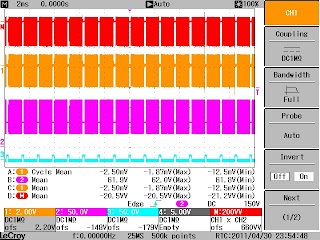
Kindest regards,
Rosemary
the following posted from Overunity.com
Then Guys - and in conclusion - in the space of a few short minutes - with an increased frequency - it then took the temperature to boiling point - I think. It wasn't actually boiling but it had small bubbles. And the temperature recorded at 104 degrees C - or thereby, from memory. No noise, surprisingly - that one associates with a kettle at boiling point. Perhaps that's the lower wattage than our kettles put out.
Anyway here's that final screen shot. The battery voltage simply rose to 62 Volts (sorry I wrote degrees) and then stabilised at that value. I didn't get that final screen shot - but that was the voltage I posted before I went to bed last night.
ADDED
NOTE that at these higher frequencies the level of oscillation across the batteries and the CSR increase.
Also. I unfortunately did NOT take a screen shot at the conclusion of that test before I increased the frequency. Because it barely took 10 minutes to raise the temperature of the water from plus/minus 80 degrees C to that 104 degrees C. And the battery voltage was absolutely stable at 62 something. I should have made another screen shot.
AND MAY I ADD, lest anyone miss the significance here - this may be the first time in recorded history that water was taken to boiling point at an evident ZERO cost of energy from a supply source. That's got to give pause for thought.

117 - this first step took water to 80 degrees centigrade with NO measurable cost from the battery supply
Dear Reader
This was an exciting test. We took water to boil 0.7 litres. There was absolutely NO evident discharge of energy from the supply. And if you look closely you'll see that during the 'on' time of the duty cycle the voltage across the shunt was only ever 'fractionally' above zero - indicating that the current flow from the battery during the on time was next to nothing.
Kindest regards,
Rosemary
The following copied over from the forum
Guys What followed on from here is a series of shots to show the results from a minor adjustment to the offset. The first screen shot shows the limit of that adjustment. There was a second adjustment during the test procedure to re-adjust the offset to return the positive back to this position. I'll down load a few of these because I actually took 15 downloads showing the same thing, essentially, with an ever but slow increase in the rise of temperature. It rose from 66.9 degrees C to it's final temperature of 240 degrees C. That's when I put it in water. And then it took the water up to 80 degrees centigrade where it pretty well stabilised. I'll post in the time it took when I've checked the time on those downloads.
Also, NOTA BENE guys, the voltage across the batteries that I mentioned in my earlier post is wrong. But just note that the battery voltage both climbs and falls - on these slower frequencies. This is most clearly evident at the very slowest fequency which is when we get that delicious oscillation that just goes on forever.
Also. I've not posted all the downloads - 15 in all - as they're too repetitive. I downloaded a screen shot at certain intervals just to relate it to temperature rise. I think I'll post three as that should be fairly representative. So. The first is to show the 'offset' detail. And two others - at the beginning and near the end - when I had to immerse it in water. Again. The water temperature then stabilsed after an hour or so - at a little over 80 degrees centigrade.
ADDED
ALSO Please note. The actual level of oscillation across the CSR reduced at those higher wattage levels. But it did nothing to stop the temperature rise. The offset was pretty well stable but I think it may have ended up fractionally 'higher' than the start of these tests.


This was an exciting test. We took water to boil 0.7 litres. There was absolutely NO evident discharge of energy from the supply. And if you look closely you'll see that during the 'on' time of the duty cycle the voltage across the shunt was only ever 'fractionally' above zero - indicating that the current flow from the battery during the on time was next to nothing.
Kindest regards,
Rosemary
The following copied over from the forum
Guys What followed on from here is a series of shots to show the results from a minor adjustment to the offset. The first screen shot shows the limit of that adjustment. There was a second adjustment during the test procedure to re-adjust the offset to return the positive back to this position. I'll down load a few of these because I actually took 15 downloads showing the same thing, essentially, with an ever but slow increase in the rise of temperature. It rose from 66.9 degrees C to it's final temperature of 240 degrees C. That's when I put it in water. And then it took the water up to 80 degrees centigrade where it pretty well stabilised. I'll post in the time it took when I've checked the time on those downloads.
Also, NOTA BENE guys, the voltage across the batteries that I mentioned in my earlier post is wrong. But just note that the battery voltage both climbs and falls - on these slower frequencies. This is most clearly evident at the very slowest fequency which is when we get that delicious oscillation that just goes on forever.
Also. I've not posted all the downloads - 15 in all - as they're too repetitive. I downloaded a screen shot at certain intervals just to relate it to temperature rise. I think I'll post three as that should be fairly representative. So. The first is to show the 'offset' detail. And two others - at the beginning and near the end - when I had to immerse it in water. Again. The water temperature then stabilsed after an hour or so - at a little over 80 degrees centigrade.
ADDED
ALSO Please note. The actual level of oscillation across the CSR reduced at those higher wattage levels. But it did nothing to stop the temperature rise. The offset was pretty well stable but I think it may have ended up fractionally 'higher' than the start of these tests.

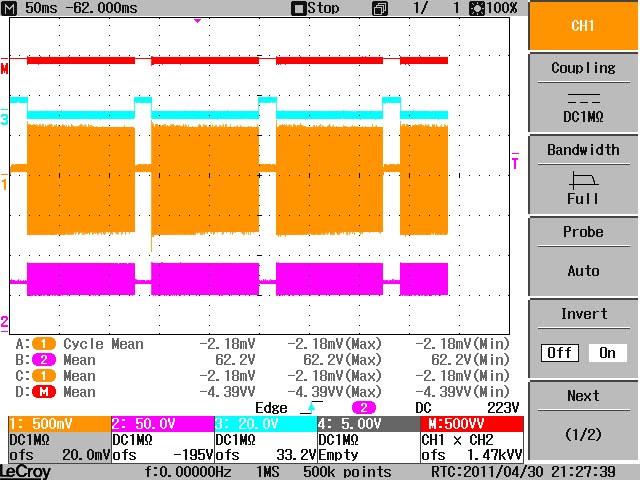

116 - first test to show the variations with different settings
Dear Reader,
This is the first test designed to show how that 'offset' varies the results
TEST
Difference in temperature rise between the extreme 'on' and 'off' settings of the duty cycle to the limit of the functions generator's capacity.
FIRST SETTING = longest on
SCRN.0336.JPG
DATE 2011/04/30
TIME 20.55.43
DUTY CYCLE 81.18% ON.
RESULTS
TEMPERATURE RISE +/- 20 degrees C greater ambient = plus/minus 2.5 watts.
MORE WATTAGE RETURNED TO V BATT THAN DELIVERED therefore INFINITE COP
SECOND SETTING = shortest on
SCRN.0339.JPG
DATE 2011/04/30
TIME 21:07:44
DUTY CYCLE 18.82% ON.
RESULTS
TEMPERATURE RISE +/- 49.8 degrees C greater ambient = plus/minus 8 watts.
MORE WATTAGE RETURNED TO V BATT THAN DELIVERED therefore INFINITE COP


This is the first test designed to show how that 'offset' varies the results
TEST
Difference in temperature rise between the extreme 'on' and 'off' settings of the duty cycle to the limit of the functions generator's capacity.
FIRST SETTING = longest on
SCRN.0336.JPG
DATE 2011/04/30
TIME 20.55.43
DUTY CYCLE 81.18% ON.
RESULTS
TEMPERATURE RISE +/- 20 degrees C greater ambient = plus/minus 2.5 watts.
MORE WATTAGE RETURNED TO V BATT THAN DELIVERED therefore INFINITE COP
SECOND SETTING = shortest on
SCRN.0339.JPG
DATE 2011/04/30
TIME 21:07:44
DUTY CYCLE 18.82% ON.
RESULTS
TEMPERATURE RISE +/- 49.8 degrees C greater ambient = plus/minus 8 watts.
MORE WATTAGE RETURNED TO V BATT THAN DELIVERED therefore INFINITE COP


115 - some interesting test results just to keep all updated
Dear Reader,
I'm simply transposing some posts across from Overunity.com that I can keep record here. They show some encouraging results. I'll post them across and then explain the significance of all this.
Kindest regards,
Rosemary
Herewith the relevant.
Ok guys. I really need to move on. What I've done is this. I can't take a photo of the set up as it is at the moment because my other computer has been rifled and doctored with a virus. And that holds my photobucket software. But what I have done is a whole lot of tests to see if I can explain this. NOTA BENE ALL. The ground of the signal generator is MOST CERTAINLY at the point marked B on the video. In other words it's BEFORE THE CSR. And by the way - it makes not an ounce of difference if it's there or if it's positioned as shown in our DEMO diagram. So. Right now the CSR is precisely in series with and on the same rail as the negative terminal of the battery supply which then conforms to my circuit variation of 'a poynted revision' shown earlier.
Then. I took the tests through an extreme range of duty cycle tests - most on - most off. This shows the advantage of the oscillation as it relates to the temperature rise. THEN I did a whole lot more tests to show the subtleties of the off set. I took the temperature to 240 degrees and climbing. But I started melting the plastic container - so I filled it with water. It took the water temperature to plus/minus 80 degrees and climbing. I think I'm dissipating upwards of 120 watts - but will only confirm this in the morning. The test has been running for the last 4 hours. And right now - on the highest frequency setting I'm FINALLY seeing evidence of battery voltage actually climbing. So is the water temperature rising - and I'm not sure how much longer I can sit up. I'm exhausted and there's nothing interesting on television to ease the boredom.
The point is this. There is absolutely no difference in where we position the ground of the functions generator. With the exception of a short 5 minutes where the offset started rising (it gets a mind of its own) there have been absolutely NO VALUES of the cycle mean - the mean - or the math trace showing anything other than a negative value. And that's notwithstanding the clear evidence of dissipation of wattage in excess of 100 watts. And I am FINALLY seeing a stable 'kick off' voltage over the batteries. It needs a high frequency.
I'll do the downloads in the morning and walk you through the different settings as they relate to the temperature rise.
PLEASE DO NOT PAY ANY ATTENTION TO POYNTY's ENDLESS INNUENDOS AND HINTS AND INTERRUPTIONS. He is talking a whole lot of nonsense. When I've done those downloads - I will then walk you through my own take on what is happening. You can take it on board - or not - as required. And Peter and Ron - as ever. Thanks for the interventions. It gets rather lonely in this corner of mine. And I missed your post there woopy. Thank you. It's always heartening and frankly, was much needed.
I'm reasonably sure that there will be those readers here who will be delighted at this. And by the same token there will be those who are not. lol.
Kindest regards,
Rosie
Just checked. Water showing some really small bubbles. We're at sea level but the temperature reading is now 104 degrees c. Shouldn't it be boiling at this level? Anyway - the voltage on the batteries now at 60 from an early 59.7. I really need to turn it off. I'll do the screen shot downloads first thing tomorrow. I'm also not sure how much water in that container. I think it's about a litre. I'll check this tomorrow as well.
edited. Added comments and corrected the spelling - I hope.
I'm simply transposing some posts across from Overunity.com that I can keep record here. They show some encouraging results. I'll post them across and then explain the significance of all this.
Kindest regards,
Rosemary
Herewith the relevant.
Ok guys. I really need to move on. What I've done is this. I can't take a photo of the set up as it is at the moment because my other computer has been rifled and doctored with a virus. And that holds my photobucket software. But what I have done is a whole lot of tests to see if I can explain this. NOTA BENE ALL. The ground of the signal generator is MOST CERTAINLY at the point marked B on the video. In other words it's BEFORE THE CSR. And by the way - it makes not an ounce of difference if it's there or if it's positioned as shown in our DEMO diagram. So. Right now the CSR is precisely in series with and on the same rail as the negative terminal of the battery supply which then conforms to my circuit variation of 'a poynted revision' shown earlier.
Then. I took the tests through an extreme range of duty cycle tests - most on - most off. This shows the advantage of the oscillation as it relates to the temperature rise. THEN I did a whole lot more tests to show the subtleties of the off set. I took the temperature to 240 degrees and climbing. But I started melting the plastic container - so I filled it with water. It took the water temperature to plus/minus 80 degrees and climbing. I think I'm dissipating upwards of 120 watts - but will only confirm this in the morning. The test has been running for the last 4 hours. And right now - on the highest frequency setting I'm FINALLY seeing evidence of battery voltage actually climbing. So is the water temperature rising - and I'm not sure how much longer I can sit up. I'm exhausted and there's nothing interesting on television to ease the boredom.
The point is this. There is absolutely no difference in where we position the ground of the functions generator. With the exception of a short 5 minutes where the offset started rising (it gets a mind of its own) there have been absolutely NO VALUES of the cycle mean - the mean - or the math trace showing anything other than a negative value. And that's notwithstanding the clear evidence of dissipation of wattage in excess of 100 watts. And I am FINALLY seeing a stable 'kick off' voltage over the batteries. It needs a high frequency.
I'll do the downloads in the morning and walk you through the different settings as they relate to the temperature rise.
PLEASE DO NOT PAY ANY ATTENTION TO POYNTY's ENDLESS INNUENDOS AND HINTS AND INTERRUPTIONS. He is talking a whole lot of nonsense. When I've done those downloads - I will then walk you through my own take on what is happening. You can take it on board - or not - as required. And Peter and Ron - as ever. Thanks for the interventions. It gets rather lonely in this corner of mine. And I missed your post there woopy. Thank you. It's always heartening and frankly, was much needed.
I'm reasonably sure that there will be those readers here who will be delighted at this. And by the same token there will be those who are not. lol.
Kindest regards,
Rosie
Just checked. Water showing some really small bubbles. We're at sea level but the temperature reading is now 104 degrees c. Shouldn't it be boiling at this level? Anyway - the voltage on the batteries now at 60 from an early 59.7. I really need to turn it off. I'll do the screen shot downloads first thing tomorrow. I'm also not sure how much water in that container. I think it's about a litre. I'll check this tomorrow as well.
edited. Added comments and corrected the spelling - I hope.
Wednesday, May 11, 2011
114 - the truth behind the forum facade
Dear Reader,
To continue where I left off in my previous post. I mentioned that RomeroUK may have simply intentionally fabricated a pretense along with that rotor of his to indulge in his 15 minutes of fame. Unlikely unless he is utterly reckless and utterly mad and ultimately intends to change both his address and his name. Because a duped public are intensely confrontational and likely to resort to litigation - especially in America. Then it may be that he'd been given a 'buy out' offer. This is possible as I know something about these kinds of moves. But a 'buy out' would only be justified on patentable technologies and prior public disclosure precludes this. Unless there's a reach for licensing rights. But that requires the explicit co-operation of whole Governmental departments and the knowledge was not out there for long enough for this to be considered. Or it may be that competing interests have muscled in to test his commitment to life - the hallmark of the Mafia. But it would, self-evidently, be FAR TOO LATE. The details of that build are now imprinted on the minds of many thousands of experimental enthusiasts with a force that can only be measured against all that tenacious and riveted interest. Indeed any disclaimer would fuel rather than starve that interest.
Or it may be that RomeroUK was actually persuaded to 'con' the public - to embark on a romp of misinformation. Then the eventual admission to that duplicity would ultimately serve to remind the public that representations on Open Source generally - and on forums specifically - are NOT TO BE TRUSTED. Now - for the first time - I see some value in that exercise. And at the risk of appearing paranoid - then let me, at least, argue this case. If it is an argument based on a paranoid delusion - then there is, notwithstanding, some compelling logic for its support.
To begin with there is a muddle of misinformation related to the measurement of energy. All that talent that abounds on these forums - and it is not inconsiderable - has at its foundation a real weakness - an Achilles heel - that cripples every endeavor at unity breach - at the get go. This may be somewhat offensive to read - but it is a truth that really needs exposure. To measure the actual energy that is delivered by an energy supply source is the simplest of ALL sums. When one generates waveforms that are NOT either pure sine waves or purely direct current then on needs to apply a small shunt resistor - a resistor that has a low Ohms value - precisely at the negative or positive rail of that supply source. Take a measure of the voltage across that resistor to determine it's amperage and then multiply it with the voltage delivered from that supply. That will give you a measure of instantaneous wattage. THAT IS IT. There are further refinements - obviously - but that's the essence. For some reason - possibly to show off one's talents and facilities with rotor turns, with subtle measurements around inductors - whatever the reason - this is simply never done. It was not done on Bedini's motors. It was not done on Romero's motor. And as a result there is simply NEVER a conclusive result in the evaluation of any motor's efficiency. And that I, who am a self confessed amateur, need to explain this - will be doubly offensive. I apologise. But it's a fact. And it needs to be addressed - URGENTLY - if one is ever going to accurately assess the output from a supply source. Which means that any evidence of a turning rotor - be it for an hour or indefinitely - its energy output is CERTAINLY calculable.
So. To use a motor for proof of unity breach is PERFECT. Not only does the rotor fixate the attention of most of the forum experimentalists - but the results can be debated forever. Long winded - winding - pretentious argument. A parade of complex detail that tangles itself in repetitious nonsense - in showing off. The perfect circular argument that has no beginning and no end. And as in most such displays - it achieves absolutely nothing. Whether or not Romero's device was a fake or whether it was real - most certainly one could evaluate whether it breached those unity barriers. And if it was/is real then it most certainly exceeds/exceeded the co-efficient of performance - that COP factor - by, dare I say it, that 'i' word. INFINITELY. And I would put money on it that Bedini's motors and many, many others that all you guys have built over the years, there are many there that BREACH those energy barriers. I am reasonably certain that COP>1 is there - all over the place. But you cannot find it - precisely because you are NOT measuring it properly.
So. The use of the motor was an ideal device to capture attention. Then. It is understood that while the debate rages against the validity of our own claims - what is incontestable is that it generates a great deal of interest. Co-incidentally I was advised of Romero's thread by a forum member whom I trust. But I was also, out of the blue - sent an email by someone called carol maguire (she doesn't use capitals in her name) - someone who asked me to PLEASE REFERENCE the work being done by Romero. I obliged. I went to the thread - and I responded. I immediately advised all and sundry to go there and pay attention. Whoever wrote to me obviously also relied on my unequivocal support for any technology that may lead to cleaner greener. In other words - I was used - as a kind of news agent - to bring this little noticed work to the attention of those many who follow our own work. The fact that it was a woman who advised me also and most definitely solicited my co-operation. Who better than me knows the rarity of any female engagement in this cutting edge science. My sympathies were immediately aroused. Of course I'd co-operate. But clearly it was also required that more of the public engage in this fiasco. I was as good a source of this as any to focus the required attention.
Then. The co-incidence. Glen Lettenmaier - who posts under the name FuzzyTomCat - and more recently fuzzytomcat - was banned from posting at energetic forum. In fact that's not the whole of the truth. What Stefan Hartman, the forum owner and moderator - advised Glen was that he could post under a different identity and that he was not allowed to join the forum if he continued with his 'flaming'. Then - out of the blue - Stefan advised Glen that he may now post again - with his full identification. And no requirement to constrain those 'flaming' compulsions of his. So. Precisely when the focus of the forum members was meant to be exclusively engaged with Romero's hoopla - then Fuzzy was meant to come to our thread and flame it to death. I am certainly not imagining this. Because - if I may now present some more evidence - I complained to Stefan about the inappropriateness of those posts. And instead of moderating Stefan wrote me an UTTERLY DISCOURTEOUS email - where he not only did not reference me by name - but declared - mandated - ordered - that we HAVE to do the test without a functions generator and that he was thinking of closing the thread. I protested and my protests have been ignored or unanswered.
Now. If I were a forum member who ostensibly promoted over unity technologies - and, in fact, was only interested in frustrating them - then I would learn from history. Nothing will engage the interests of those members of this forum more than to busy themselves with those beloved and preferred motors. And even if there is that abrupt denial of the fact then the inclinations of that great collective heart - that enduring love of all you guys - the spinning rotor that may spin forever - that will most CERTAINLY be reawakened. It will still engage all your interests for some time to come.
And then - more to the point - with that subsequent denial, then those many readers of those forums - those with better discernment and greater objectivity - will only be able to conclude that any forum representations, any Open Source submissions - are likely to be unreliable - and most likely fraudulent. So. If, as there is, any extant and looming threat of a 'valid claim' to unity breach - then that too will be tarnished by association. And that's the point. You are all encouraged to debate overunity. You are actively prevented from proving it. And that proof is just so easy - and yet the logic eludes all you brilliant engineers. What gives? Our own proof is abundant. But it's still being debated for Heaven's sake.
And that Harti regrets my own involvement on his forum is self-evident. This is a chapter all on its own. But his refusal to afford any moderation - is in defiance of his own forum rules. In effect he is discouraging any furtherance of this technology based on what? That I am not capable of building the schematic that he requires? That I am lying about the results that are shown by our LeCroy? Which are also endorsed by our Tektronix? That the video results that were presented on the device were fraudulent? That there are ground issues that pertain to our device? Which by the way are also concerns that are roundly denied by simulations of our schematic? That our power measurement analysis is wrong when they indeed conform PRECISELY to the required protocols? What? Why is he that anxious to get rid of me and the information along with it? Why - if he is that anxious to promote overunity technology is he prepared to get rid of our claims? I would have thought that any evidence at all requires nurture.
I'm at a loss. I do know that he resented our non-disclosure of that rather eccentric MOSFET positioning. But that was required - by all who had been involved in the progress of this technology. It was an issue that was considered closely - on many levels. Glen Lettenmaier is on record. He claims ownership or discovery of what is widely referred to as the Rosemary Ainslie circuit. Would he or others come forward and claim the ownership or discovery of that unusual MOSFET configuration? It was a valid and real concern. Our best protection was intended to show this to experts - to one or more persons with a Doctorate or Professorial title - at a public demonstration. Their comments would then have merited publicity or publication. Either would have been welcome. BUT. Those experts did not attend. Nor did they advise me that they would not be attending. And our intention was to protect that knowledge until then. Because then no-one would be able to claim that for themselves as their own discovery. And it's hardly likely to advance our cause if there are those that still try and pretend that we are plagiarising their work. And the sad reality is that Open Source advances these types of opportunists.
Which, I think, concludes this analysis. And my conclusion is this. I am not sure that there are any forums that are dedicated to promote overunity or clean green - notwithstanding their claims to the contrary. And for those members within those forums who are engaged in a genuine reach - then you need to learn how to do some simple power measurements. Because until you do then any valid claims will be contended. And worst still - existing circuits and already built apparatus - are likely to surprise you all with their results when the measurements are appropriately applied. You may indeed find that elusive evidence of COP>1. But for some reason you never seem to get around to measuring this.
Kind regards,
Rosemary
To continue where I left off in my previous post. I mentioned that RomeroUK may have simply intentionally fabricated a pretense along with that rotor of his to indulge in his 15 minutes of fame. Unlikely unless he is utterly reckless and utterly mad and ultimately intends to change both his address and his name. Because a duped public are intensely confrontational and likely to resort to litigation - especially in America. Then it may be that he'd been given a 'buy out' offer. This is possible as I know something about these kinds of moves. But a 'buy out' would only be justified on patentable technologies and prior public disclosure precludes this. Unless there's a reach for licensing rights. But that requires the explicit co-operation of whole Governmental departments and the knowledge was not out there for long enough for this to be considered. Or it may be that competing interests have muscled in to test his commitment to life - the hallmark of the Mafia. But it would, self-evidently, be FAR TOO LATE. The details of that build are now imprinted on the minds of many thousands of experimental enthusiasts with a force that can only be measured against all that tenacious and riveted interest. Indeed any disclaimer would fuel rather than starve that interest.
Or it may be that RomeroUK was actually persuaded to 'con' the public - to embark on a romp of misinformation. Then the eventual admission to that duplicity would ultimately serve to remind the public that representations on Open Source generally - and on forums specifically - are NOT TO BE TRUSTED. Now - for the first time - I see some value in that exercise. And at the risk of appearing paranoid - then let me, at least, argue this case. If it is an argument based on a paranoid delusion - then there is, notwithstanding, some compelling logic for its support.
To begin with there is a muddle of misinformation related to the measurement of energy. All that talent that abounds on these forums - and it is not inconsiderable - has at its foundation a real weakness - an Achilles heel - that cripples every endeavor at unity breach - at the get go. This may be somewhat offensive to read - but it is a truth that really needs exposure. To measure the actual energy that is delivered by an energy supply source is the simplest of ALL sums. When one generates waveforms that are NOT either pure sine waves or purely direct current then on needs to apply a small shunt resistor - a resistor that has a low Ohms value - precisely at the negative or positive rail of that supply source. Take a measure of the voltage across that resistor to determine it's amperage and then multiply it with the voltage delivered from that supply. That will give you a measure of instantaneous wattage. THAT IS IT. There are further refinements - obviously - but that's the essence. For some reason - possibly to show off one's talents and facilities with rotor turns, with subtle measurements around inductors - whatever the reason - this is simply never done. It was not done on Bedini's motors. It was not done on Romero's motor. And as a result there is simply NEVER a conclusive result in the evaluation of any motor's efficiency. And that I, who am a self confessed amateur, need to explain this - will be doubly offensive. I apologise. But it's a fact. And it needs to be addressed - URGENTLY - if one is ever going to accurately assess the output from a supply source. Which means that any evidence of a turning rotor - be it for an hour or indefinitely - its energy output is CERTAINLY calculable.
So. To use a motor for proof of unity breach is PERFECT. Not only does the rotor fixate the attention of most of the forum experimentalists - but the results can be debated forever. Long winded - winding - pretentious argument. A parade of complex detail that tangles itself in repetitious nonsense - in showing off. The perfect circular argument that has no beginning and no end. And as in most such displays - it achieves absolutely nothing. Whether or not Romero's device was a fake or whether it was real - most certainly one could evaluate whether it breached those unity barriers. And if it was/is real then it most certainly exceeds/exceeded the co-efficient of performance - that COP factor - by, dare I say it, that 'i' word. INFINITELY. And I would put money on it that Bedini's motors and many, many others that all you guys have built over the years, there are many there that BREACH those energy barriers. I am reasonably certain that COP>1 is there - all over the place. But you cannot find it - precisely because you are NOT measuring it properly.
So. The use of the motor was an ideal device to capture attention. Then. It is understood that while the debate rages against the validity of our own claims - what is incontestable is that it generates a great deal of interest. Co-incidentally I was advised of Romero's thread by a forum member whom I trust. But I was also, out of the blue - sent an email by someone called carol maguire (she doesn't use capitals in her name) - someone who asked me to PLEASE REFERENCE the work being done by Romero. I obliged. I went to the thread - and I responded. I immediately advised all and sundry to go there and pay attention. Whoever wrote to me obviously also relied on my unequivocal support for any technology that may lead to cleaner greener. In other words - I was used - as a kind of news agent - to bring this little noticed work to the attention of those many who follow our own work. The fact that it was a woman who advised me also and most definitely solicited my co-operation. Who better than me knows the rarity of any female engagement in this cutting edge science. My sympathies were immediately aroused. Of course I'd co-operate. But clearly it was also required that more of the public engage in this fiasco. I was as good a source of this as any to focus the required attention.
Then. The co-incidence. Glen Lettenmaier - who posts under the name FuzzyTomCat - and more recently fuzzytomcat - was banned from posting at energetic forum. In fact that's not the whole of the truth. What Stefan Hartman, the forum owner and moderator - advised Glen was that he could post under a different identity and that he was not allowed to join the forum if he continued with his 'flaming'. Then - out of the blue - Stefan advised Glen that he may now post again - with his full identification. And no requirement to constrain those 'flaming' compulsions of his. So. Precisely when the focus of the forum members was meant to be exclusively engaged with Romero's hoopla - then Fuzzy was meant to come to our thread and flame it to death. I am certainly not imagining this. Because - if I may now present some more evidence - I complained to Stefan about the inappropriateness of those posts. And instead of moderating Stefan wrote me an UTTERLY DISCOURTEOUS email - where he not only did not reference me by name - but declared - mandated - ordered - that we HAVE to do the test without a functions generator and that he was thinking of closing the thread. I protested and my protests have been ignored or unanswered.
Now. If I were a forum member who ostensibly promoted over unity technologies - and, in fact, was only interested in frustrating them - then I would learn from history. Nothing will engage the interests of those members of this forum more than to busy themselves with those beloved and preferred motors. And even if there is that abrupt denial of the fact then the inclinations of that great collective heart - that enduring love of all you guys - the spinning rotor that may spin forever - that will most CERTAINLY be reawakened. It will still engage all your interests for some time to come.
And then - more to the point - with that subsequent denial, then those many readers of those forums - those with better discernment and greater objectivity - will only be able to conclude that any forum representations, any Open Source submissions - are likely to be unreliable - and most likely fraudulent. So. If, as there is, any extant and looming threat of a 'valid claim' to unity breach - then that too will be tarnished by association. And that's the point. You are all encouraged to debate overunity. You are actively prevented from proving it. And that proof is just so easy - and yet the logic eludes all you brilliant engineers. What gives? Our own proof is abundant. But it's still being debated for Heaven's sake.
And that Harti regrets my own involvement on his forum is self-evident. This is a chapter all on its own. But his refusal to afford any moderation - is in defiance of his own forum rules. In effect he is discouraging any furtherance of this technology based on what? That I am not capable of building the schematic that he requires? That I am lying about the results that are shown by our LeCroy? Which are also endorsed by our Tektronix? That the video results that were presented on the device were fraudulent? That there are ground issues that pertain to our device? Which by the way are also concerns that are roundly denied by simulations of our schematic? That our power measurement analysis is wrong when they indeed conform PRECISELY to the required protocols? What? Why is he that anxious to get rid of me and the information along with it? Why - if he is that anxious to promote overunity technology is he prepared to get rid of our claims? I would have thought that any evidence at all requires nurture.
I'm at a loss. I do know that he resented our non-disclosure of that rather eccentric MOSFET positioning. But that was required - by all who had been involved in the progress of this technology. It was an issue that was considered closely - on many levels. Glen Lettenmaier is on record. He claims ownership or discovery of what is widely referred to as the Rosemary Ainslie circuit. Would he or others come forward and claim the ownership or discovery of that unusual MOSFET configuration? It was a valid and real concern. Our best protection was intended to show this to experts - to one or more persons with a Doctorate or Professorial title - at a public demonstration. Their comments would then have merited publicity or publication. Either would have been welcome. BUT. Those experts did not attend. Nor did they advise me that they would not be attending. And our intention was to protect that knowledge until then. Because then no-one would be able to claim that for themselves as their own discovery. And it's hardly likely to advance our cause if there are those that still try and pretend that we are plagiarising their work. And the sad reality is that Open Source advances these types of opportunists.
Which, I think, concludes this analysis. And my conclusion is this. I am not sure that there are any forums that are dedicated to promote overunity or clean green - notwithstanding their claims to the contrary. And for those members within those forums who are engaged in a genuine reach - then you need to learn how to do some simple power measurements. Because until you do then any valid claims will be contended. And worst still - existing circuits and already built apparatus - are likely to surprise you all with their results when the measurements are appropriately applied. You may indeed find that elusive evidence of COP>1. But for some reason you never seem to get around to measuring this.
Kind regards,
Rosemary
113 - strange happenings on the forums
Dear Reader,
RomeroUK is an avid forum contributor and active on the internet. As mentioned he claimed and showed a motor that perpetually spins. When I referred to his work in my thread his hits were negligible. Thereafter there was an explosion of interest and that interest then spread across all forums like a rash. But with the speed of a bush fire. All were captivated. And the forum owner, Stefan Hartman, rallied to protect both Romero and ALL that information. And he summarily banned the nay sayers and deleted their posts. In short, Romero was offered a degree of protection and a level of courtesy that I, personally, have never experienced. On the contrary.
Then. The news was still days old - the excitement growing - when he posted a short statement on the thread saying words to the effect that 'sorry - it was all fake - stop your replications'. And even then, amazingly - all APOLOGISE, if you don't mind, for bothering him in the first instance, for showing interest in his work. 'Sorry Romero - we were all too keen'.
Good heavens. Why would ANYONE make public - information that is simply designed to 'hoax' the public? I cannot get my head around this. Why spend real money on building anything at all - why waste time - if it simply doesn't work? Is it the result of a frustrated builder who WANTS it to work? WANTS some kind of overunity result notwithstanding his experimental failures? I suppose that's possible. Then the intention is simply to enjoy the attention that first motivated that build.
And by the same token it could have been the result of some kind of 'buy out' where Romero was withholding critical information that the device could still be patented. But it would have to be hidden information - or it most certainly is NOT patentable. And frankly he seemed to 'show all'. I can see nothing hidden. And I've looked and looked. But then my eyes are not the best. And if anyone could miss anything then I'm somewhat overqualified. lol In any event, unless there was still something 'hidden' from view - then there was no buyout.
That leaves the 'last but one', option. He had, apparently, disclosed his physical address. He's a young man. Is is possible that he was physically coerced - someone threatened him - or his family - to withdraw those claims? Notwithstanding - or precisely because of - the truth of those presentations, competing interests muscled in and reminded him of his will to live? Again. If this was the case and if, indeed, he was 'instructed' to trumpet that work as a 'fake' then that trumpet call is WAY TOO LATE. The cat's already out the bag. And it's running around the globe at pace and absolutely unstoppable. The details of that build are available to all. All can still replicate. So that threat would have no force and effect. One single denial is hardly likely to stop the interest in further builds. On the contrary. We know the compulsive interests of engineers when it comes to the building of motors. I would have thought that - if anything - a denial after this particular fact would generate more rather than less interest.
Which brings me to the final possibility. Could it be that Romero was somehow encouraged to build a working motor with the mandate to ultimately acknowledge the hoax - the mandate to eventually disclaim its effectiveness - simply to take the attention away from other competing and valid claims? Here there would, indeed, be some actual merit in all that hoopla. A reminder to the general public to IGNORE any claims that relate to overunity - ever. Another 'scar' on the face of Open Source? A way to discourage interest in this movement - this reach of ours?
Frankly this is what I suspect. I'll elaborate more fully hereafter.
Kidnest regards,
Rosemary
RomeroUK is an avid forum contributor and active on the internet. As mentioned he claimed and showed a motor that perpetually spins. When I referred to his work in my thread his hits were negligible. Thereafter there was an explosion of interest and that interest then spread across all forums like a rash. But with the speed of a bush fire. All were captivated. And the forum owner, Stefan Hartman, rallied to protect both Romero and ALL that information. And he summarily banned the nay sayers and deleted their posts. In short, Romero was offered a degree of protection and a level of courtesy that I, personally, have never experienced. On the contrary.
Then. The news was still days old - the excitement growing - when he posted a short statement on the thread saying words to the effect that 'sorry - it was all fake - stop your replications'. And even then, amazingly - all APOLOGISE, if you don't mind, for bothering him in the first instance, for showing interest in his work. 'Sorry Romero - we were all too keen'.
Good heavens. Why would ANYONE make public - information that is simply designed to 'hoax' the public? I cannot get my head around this. Why spend real money on building anything at all - why waste time - if it simply doesn't work? Is it the result of a frustrated builder who WANTS it to work? WANTS some kind of overunity result notwithstanding his experimental failures? I suppose that's possible. Then the intention is simply to enjoy the attention that first motivated that build.
And by the same token it could have been the result of some kind of 'buy out' where Romero was withholding critical information that the device could still be patented. But it would have to be hidden information - or it most certainly is NOT patentable. And frankly he seemed to 'show all'. I can see nothing hidden. And I've looked and looked. But then my eyes are not the best. And if anyone could miss anything then I'm somewhat overqualified. lol In any event, unless there was still something 'hidden' from view - then there was no buyout.
That leaves the 'last but one', option. He had, apparently, disclosed his physical address. He's a young man. Is is possible that he was physically coerced - someone threatened him - or his family - to withdraw those claims? Notwithstanding - or precisely because of - the truth of those presentations, competing interests muscled in and reminded him of his will to live? Again. If this was the case and if, indeed, he was 'instructed' to trumpet that work as a 'fake' then that trumpet call is WAY TOO LATE. The cat's already out the bag. And it's running around the globe at pace and absolutely unstoppable. The details of that build are available to all. All can still replicate. So that threat would have no force and effect. One single denial is hardly likely to stop the interest in further builds. On the contrary. We know the compulsive interests of engineers when it comes to the building of motors. I would have thought that - if anything - a denial after this particular fact would generate more rather than less interest.
Which brings me to the final possibility. Could it be that Romero was somehow encouraged to build a working motor with the mandate to ultimately acknowledge the hoax - the mandate to eventually disclaim its effectiveness - simply to take the attention away from other competing and valid claims? Here there would, indeed, be some actual merit in all that hoopla. A reminder to the general public to IGNORE any claims that relate to overunity - ever. Another 'scar' on the face of Open Source? A way to discourage interest in this movement - this reach of ours?
Frankly this is what I suspect. I'll elaborate more fully hereafter.
Kidnest regards,
Rosemary
Subscribe to:
Posts (Atom)